Sometimes you just want to curl up under a blanket. With a good book. A piece of chocolate. A man.
This is what Deborah Azzopardi’s pictures make me feel like doing. They are me. They remind me of the time I had a red convertible sports car. I had two, actually. And yes, they are you, too.
You immediately, automatically, engage with the narrative of Azzopardi’s conversational visual humour. Laughter is the best aphrodisiac, as you know. Never before has the erotic dream been painted by a woman so well. Think of all the furtively duplicitous sexual innuendos (worth seeing) in art history, made for the titillation of the male patron; one of the purposes of art being to arouse emotions, yes. Whilst I see some Japanese Shunga prints coarse next to Azzopardi’s more idealistic visions of contemporary urban life, the fantastical makes Azzopardi playfully sexy. And fun! Her pictures make you feel the same way, as she makes you feel the atmosphere of what goes on behind closed doors.
Azzopardi gives your fantasies a place to live, and grow, aside from the likes of Millais’s Pre-Raphaelite, ‘Isabella’, where Freudian-slips slip up against Victorian prudish angst and erections in the shadows. Azzopardi is more titillating than salacious, more sensual than sexual.
Distinctive, memorable and provocative, Azzopardi’s Pop Art shows what happens to the protagonist as her canvas acts like a storyboard for movies. Azzopardi’s definitely got the ‘When Harry Met Sally….’ – “I’ll have what she’s having” at the Katz’s Delicatessen scene, down to a fine art, in paint.
How does Azzopardi choose her topics? “I don’t choose them,” she says. “Really they choose me. I am inspired by everything I see and hear.” There’s plenty of art historical references from Dali’s frivolous daydreaming joy to Michelangelo’s abandonment of sexual fantasy; with Brancussi’s physical, bodily, dynamics through to Manet’s suggestive ‘Olympia’; Boucher’s thought-provoking, and groin-stimulating, ‘Louise O’Murphy’; Fragonard’s frivolous, knickerless, ‘The Swing’; and Courbet’s glowing ‘The Origin of the World’. But, coming from the male artist, you’d notice art history tends to sexualise art for the male patron because it’s been created by a man. Azzopardi does it her way, not in a vulgar way, through a Graphic-Figurativism that liberates women a step further than Gauguin liberated the girl with Primivitism. Further, Azzopardi is seductive with a non-threatening touch – it is fantasy, in a non-threatening way, like being comfortable with your G.B.F. (Gay Best Friend) discussing your bra size.
Provocative, flirtatious and wonderfully highlighted by playful titles, Azzopardi’s narratives interlink one painting to her next as the story progresses with messages of love and the stories of many. Juxtaposing lines of comic-book text with saucy images within a snap-shot canvas, Azzopardi paints all that you dare to fantasise about.
Unique in approach, you easily recognise an Azzopardi picture. America has Lichtenstein we have Azzopardi. Working simple graphics and toned shading (for depth), the Pop Art line that Azzopardi sketches is different to Lichtenstein’s. Hers is more curvaceous. Feminine. Whereas his lines are male, brash and clunky. And her humour is distinctively British. With the slap-and-tickle, kiss-me-quick, fun of Carry On films and quintessentially English seaside-pier-art where you poke your head through the cut-out cartoon, putting yourself in the picture. “Flash, bang, wallop! What a picture! What a photograph!” (Tommy Steele as Arthur Kipps in the London musical, ‘Half a Sixpence’). We’ve all been there done that, to be a part of visual curvaceous comedy as breasts spill over necklines, buttocks plump under panties and Y-Fronts jockey as floppy sun hats, on the English seaside coast.
Although her large colour surfaces may be simple and basic, she knows how colour works, how to use colour, so she’s not afraid to be simple and basic. It’s natural. Instinctive, like good sex is. Azzopardi’s art makes me think of the poster for ‘The Graduate’ movie when Mrs Robinson (Anne Bancroft) puts on her stockings to seduce Benjamin Braddock (Dustin Hoffman). And just as intimate as Dutch Golden Age paintings, where flirtatious bedroom games are real, Azzopardi references Vermeer in, ‘The Girl with the Diamond Earring’ (made with real diamond dust).
Azzopardi’s simple equations equal simple compositions. Timeless moments of silence that concentrate your concentration. Employing quite a Classical, Medieval, perspective, combined with bold, yet subtle gradations of colour, actually makes Pop-Art-Azzopardi more of a Formal artist. As shadows enable the texture of skin, free-flowing hair, and tender, yielding, flesh, we’d all love to look like an Azzopardi’s woman semi-nude.
Azzopardi’s use of light is an important issue too. The glow, radiance, coming from her portraits highlight the importance of personality. And the importance of experiences as ideas. This has to do with utilising the old-world aesthetics the art world has always, traditionally, celebrated. From the long-established poster-art graphics, as drawn by Toulouse-Lautrec to exude his colourful, flippant, but nevertheless elegant, sensitive and intimate message. Azzopardi, witty and thought provoking, also falls under Magritte’s Surrealist umbrella of suggestive, theatrical, poetic symbolism, as concealed in her stunning 24 carat image, ‘Pure Gold’, where lipstick is seductively applied. And of course it is red lipstick, red lips symbolise being ready for ‘intimate’ contact. When Renoir said, he’d, “painted pictures with my prick”, Azzopardi surely grabbed his baton-paintbrush, becoming the Emily Pankhurst of the art world, shaping women for our time, ensuring they never go back to the kitchen sink again. Unless they’re wearing just an apron, you’d expect.
What is ‘Push Once’ all about? A little bit of James Bond? A little bit of the Apollo 11 first moon landing? A nipple? No it’s a traditional London Routemaster bus bell. Playful, these images are foreplay. Paintings to flirt by. Paintings to fall in love by, and with. Like Manet’s art is art to flirt by, watch out, love is blooming here. Each portrait is a revelation, for ‘She’ is the girl of our day that we meet in the street. She is also Venus encompassing beauty and love. ‘He’ is Casanova, or David Beckham if you’d rather. Remember when Sam Taylor-Wood made her video-portrait of Beckham asleep, everyone – young, old, female and male, queued up to take their selfie ‘sleeping’ with him.
What inspires Deborah? “Laughter. Laughter is the best source of inspiration. Things that make you smile, or even thoughtful …. Museums, books, people; family and friends most importantly. Everything in life that surrounds me. I keep open minded and try to ‘see’ rather than just look.”
‘Close’ and ‘Closer’ are not a pair but are stunning together. This Renaissance referencing diptych makes these paintings of two parts become one as Azzopardi adopts Botticelli’s graceful, linear, rhythm. There is a sense of movement in Azzopardi’s pictures, a sense of Futurist movement. See the man’s handkerchief wiping the broken hearted woman’s tears away in ‘Forever, and ever ….’. Entitled after Aretha Franklin’s hit song, with synaesthesia, you’d hear Ms Franklin singing “I Say A Little Prayer”for you, as, music is the visual metaphor for love, the harmony being between a man and woman. Likewise there are also powerful moments of silence, as characters appear to be caught frozen in time. She uses humour to make her art timeless and enduring. The popularity of her image is similar to that enjoyed by the ‘Chinese Girl’ in the 1950s and 60s, by Vladimir Tretchikoff.
Like a pared-down Patrick Caulfield, with simple black outlines, and, big, flat, single hue, colour, Azzopardi says, “I love the use of colour on a large scale. To me the impact is in the size of the painting with the dynamism of colour.” Much in the same vein as Yves Klein had his blue, Azzporadi has hers. Her colours serve as initial bait to gain your attention, but it is her subject matter that hooks you in, and keeps you captivated, as male torsos are toned and long female legs dangle over the side of a red convertible.
What makes her paint? She just likes to paint. “I have always wanted to paint! I don’t understand why everyone in the world doesn’t paint! It’s probably like an addiction. Although I’m not an addict. Only to chocolate! I think I just paint because I like the subject idea, without any great meaning or explanation.” Says Azzopardi. Even the fashion illustrator from the haute couture world of major designers, René Gruau, makes Azzopardi want to paint. It’s his elegant, economic, use of line.
Like Gruau, Azzopardi draws from real life models too. Beautifully honed, Ralph Lauren model-types, with pert breasts and firm thighs can be seen to be as iconic as Leonardo’s ‘Mona Lisa’, Warhol’s ‘Monroe’ or Goya’s ‘The Naked Maja’. Except, each of Azzopardi’s portraits has three faces. One facing the past of art history; one facing our time – the ‘here-and-now’; and one facing tomorrow – the future.
There is something ‘Wonder Woman’-esque about her colourful pictures that makes you believe the girl is the superhero who triumphs not with punches or kicks, but with love. Images, as bright and bold as I used to be. Indeed can be again, for something about them makes me feel young, like I’m standing by the Fountain of Youth. Youth symbolizes incorruptible purity.
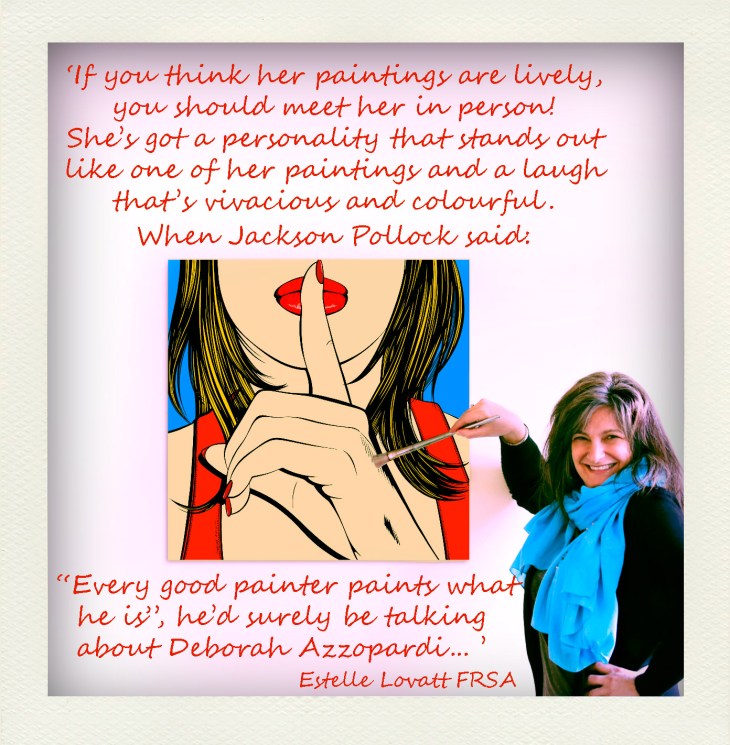
If you think her paintings are lively, you should meet her in person! She’s got a personality that stands out like one of her paintings and a laugh that’s vivacious and colourful. When Jackson Pollock said, “Every good painter paints what he is”, he’d surely be talking about Deborah Azzopardi ….
Essay published in 2014, in Deborah Azzopardi’s debut book.
Images design by Cristina Schek, using artwork by Deborah Azzopardi & quotes by Estelle Lovatt FRSA.
© Estelle Lovatt FRSA