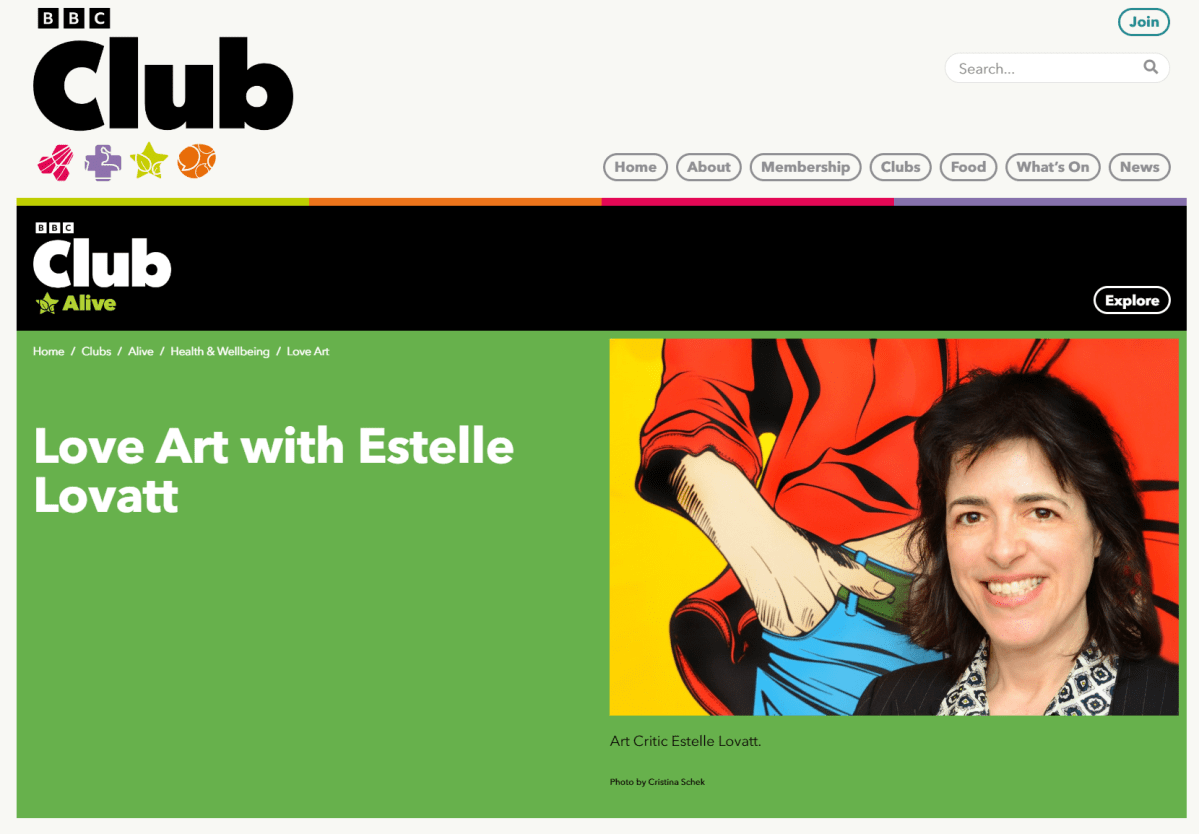
Estelle Lovatt will be sharing her passion for the arts via BBC Club Alive.
This will include:
Interviews with those connected to the art world
Art courses @ LBH using dry art materials
Lectures
Historical walks and talks
Art Coaching
Exhibition reviews
About Estelle
Art Critic Estelle Lovatt FRSA has the experience of being on both sides of the canvas, having trained as a painter, read Art History and as a gallery exhibition curator, Estelle is able to teach, judge and talk about works of art, from Cave Art to Banksy, with expert opinion.
She has worked as a freelance art critic for the BBC as well as for various independent Radio stations throughout the UK.
New exhibition at the National Gallery plus Walk Constable’s Hampstead with art historian Estelle Lovatt.
As part of the National Gallery’s Bicentenary celebrations, Discover Constable & The Hay Wain, 17 October to 2 February, 2025, will focuss on and explore John Constable’s lush green masterpiece, The Hay Wain, painted in 1821.
This exhibition will look at how the great Romantic Realist artist’s perspective of the English landscape reformed itself from social, political and physical assessment and how much the Old Masters were a huge influence from Michelangelo to Ruisdael, Rubens, van Goyen and Claude. Artworks by William Blake, George Morland and John Linnell will also be included.
The exhibition
National Gallery, London, Sunley Room
17 October 2024 – 2 February 2025
Admission free
Walk in Constable’s footsteps with Estelle Lovatt
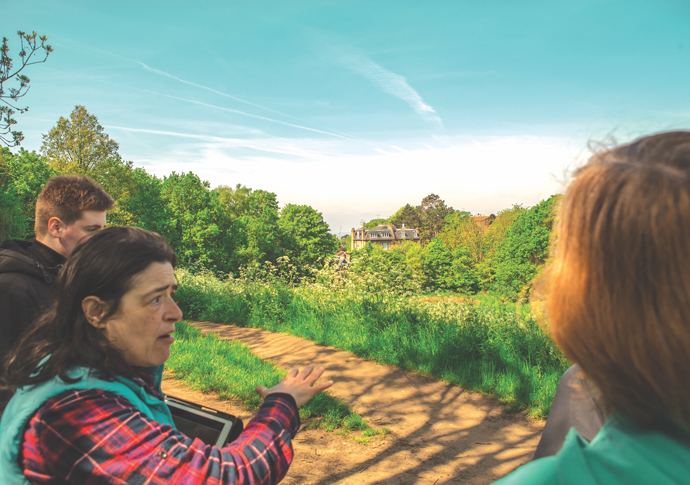
Enjoy an opportunity to walk in Constable’s footsteps as Estelle Lovatt FRSA, art historian, art critic, and professional artists’ mentor, hosts guided walking tours, taking you to where Constable painted his masterpieces in London.
This, is a great complimentary event to the National Gallery’s exhibition, Discover Constable and The Hay Wain, as Estelle follows the great Romantic painter’s late life, to see where he lived, painted, sketched, worked and loved in Hampstead, London NW3.
The walks take place throughout the year. Details and tickets are available on Estelle’s Eventbrite page, Walk Constable’s Hampstead,
Constable painted his masterpiece, The Hay Wain, from drawings and studies he’d sketched over at least a twenty year period, en plein air, in Suffolk. But even after his move, from here to London, when he studied at the Royal Academy, Constable often returned to the landscape of his youth to sketch his beloved countryside. Capturing and documenting the fleeting momentary weather effects pass amidst transitory effects of daylight, all naturally occurring.
He finished The Hay Wain in his London studio – the backyard shed in the garden of his Hampstead, London NW3, home.
This magnificent “six footer” painting was exhibited at the Royal Academy, the same year it was painted, in 1821. Géricault and Delacroix admired it and, although it was quite favourably welcomed by critics saying, it ”approaches nearer to the actual look of rural nature than any modern landscape whatever”, it failed to sell.
The popularity of Constable’s work
Constable’s pictures – exceedingly popular today – were not well received in his lifetime, here, in England. But he inspired contemporary French artists from the Barbizon School and Romantic movement. As he gained significant success in France, The Hay Wain got phenomenal approval and praise when it was exhibited at the Paris Salon, and received a gold medal from the King of France, in 1824.
Nowadays, it’s considered a very lovely, traditional, image of the verdant pastoral English countryside. Even Banksy has interpreted it!
Evoking the calm rustle of being outdoors in nature by Willy Lott’s farmhouse along the River Stour, Constable developed full-sized oil paint sketches to enable him to resolve the pictorial composition.
His sketched studies, alla prima, are much admired. However, early 19th-century gallery-goers found them far too slapdash, radically expressionistic and unfathomably impressionistic, in interpreting the landscape. Today, we value these studies on paper as fascinating and insightful, pre-empting the artist’s working practice. And if Constable felt like it, he’d have no problem adding an invented rainbow – or two, designing elm trees taller than fact, or superficially brightening a horse’s red harness or boy’s waistcoat to best complement the star, principal colour, green.
The scene is about a mile from where Constable was born and spent his childhood, in East Bergholt. The place where, as Constable sympathetically wrote, he valued “The sound of water escaping from Mill dams, elms and willows, old rotten banks, slimy posts & brickwork. I love such things.”
‘Constable’s Hampstead’ Walk & Talk Tour with art historian and art critic Estelle Lovatt FRSA.
Walk in Constable’s footsteps to see where he lived, worked and painted his great iconic landscape masterpieces on the Heath, Hampstead, and around the NW3 London village, finishing at his family tomb in the church.
Estelle speaks to you, describing the story of Constable’s life, his parents, family, wife and children. His dislike of Turner and relationship with the Royal Academy. Painting ‘en plein air’ and ‘alla prima’, British Romanticism, Dutch Golden Age influences, inspiring future French Impressionism. Bringing alive everything you wanted to know about Constable, and how he painted nature, the best clouds, rays of sunshine & double rainbows in art history.
And if you want to draw where Constable sketched, bring your sketch pad and pencil!
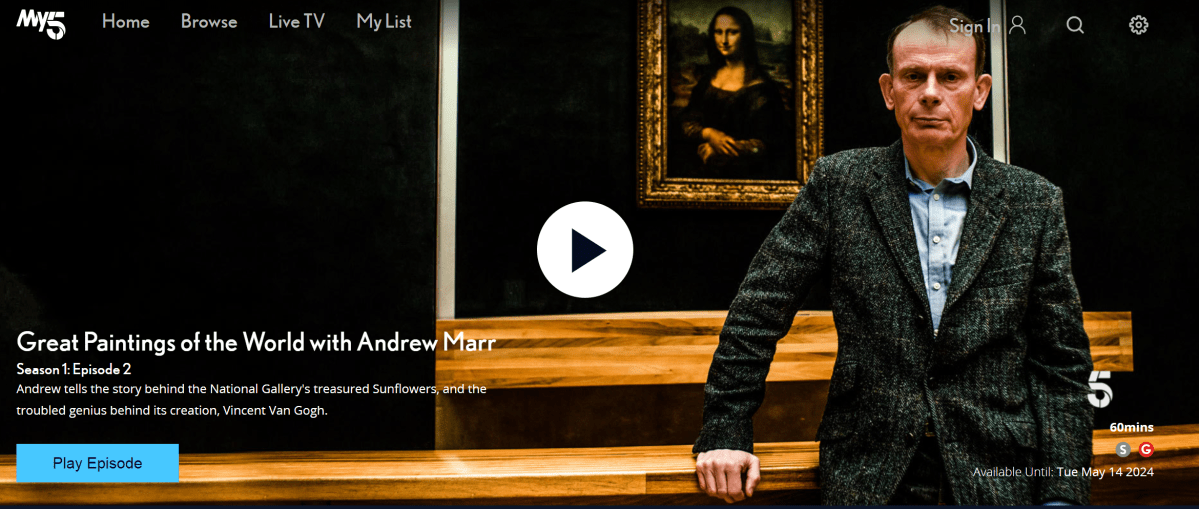
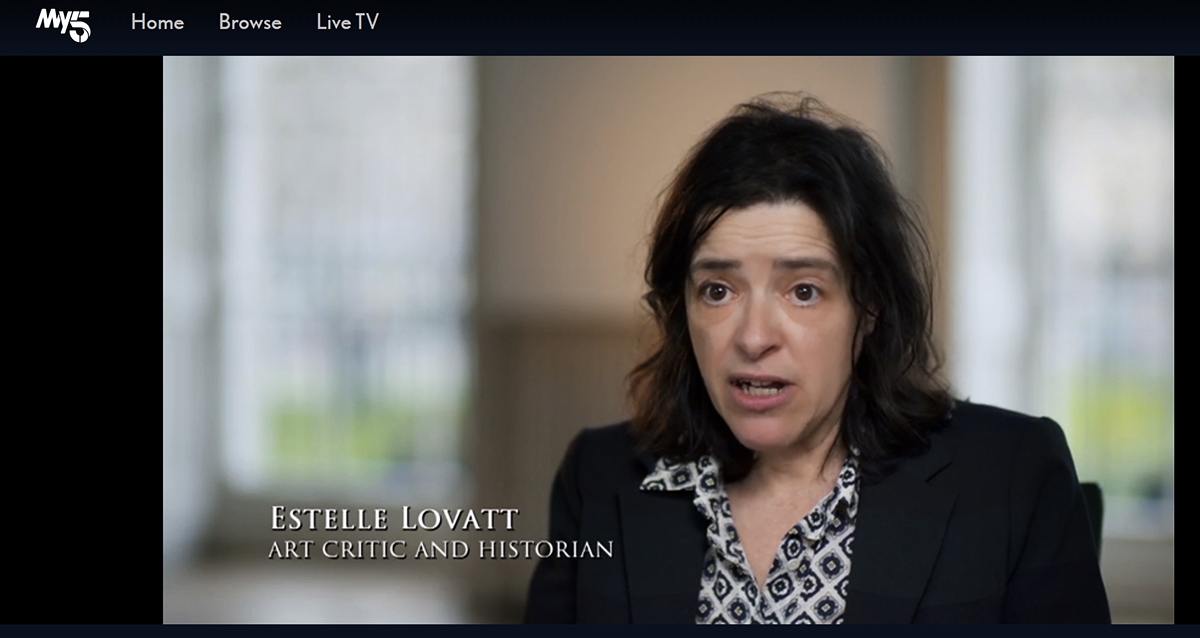
Andrew Marr tells the stories behind ten of the greatest paintings ever and I’m delighted to be one of the expert contributors giving my take on artists, art history and art throughout the 10 episodes. Watch here.
I helped trace the stories of each of these paintings – from the biography of the artist, the historical context of the painting, throughout to what became of the artist and the painting.
1 – Mona Lisa by Leonardo da Vinci, Louvre, Paris
2 – Sunflowers by Vincent van Gogh, National Gallery, London
3 – The Fighting Temeraire by Turner, National Gallery, London
4 – Weeping Woman by Pablo Picasso, Tate Britain, London
5 – The Water Lilies by Monet, Musée de l’Orangerie, Paris
6 – Hay Wain by Constable, National Gallery, London
7 – Rokeby Venus by Velázquez, National Gallery, London
8 – Night Watch by Rembrandt, Rijksmuseum, Amsterdam
9 – Ophelia by Millais, Tate Britain, London
10 – Birth of Venus by Botticelli , National Gallery, London
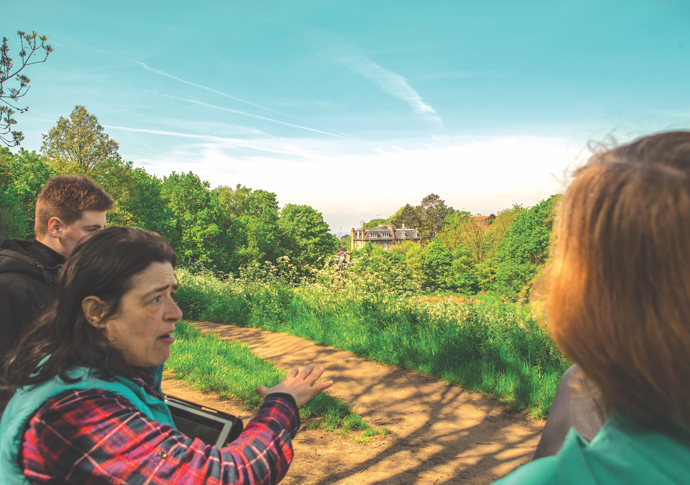
Estelle Lovatt on the Constable trail in Hampstead [Photo credit Cristina Schek]
IN John Constable’s 250th birthday anniversary year, Hampstead offers an exceptionally enlightening and informative way to re-evaluate the great English Romantic landscape painter’s accomplishments.
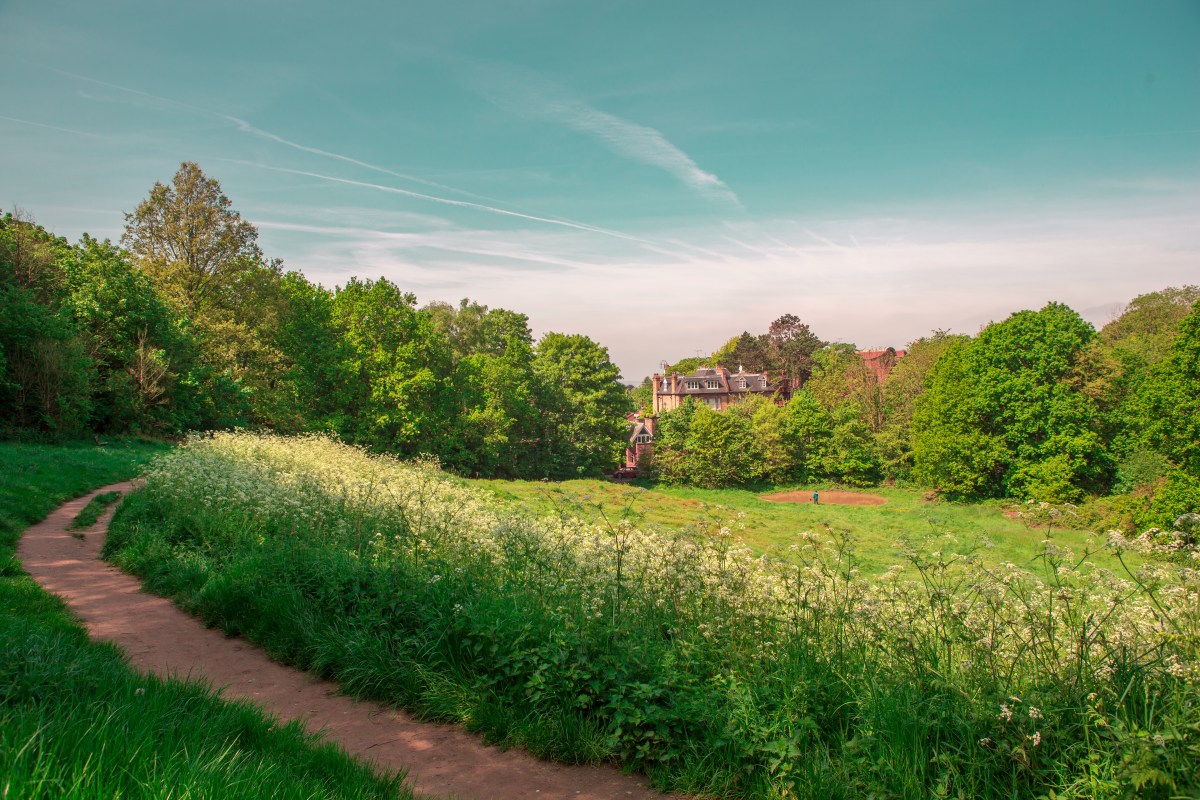
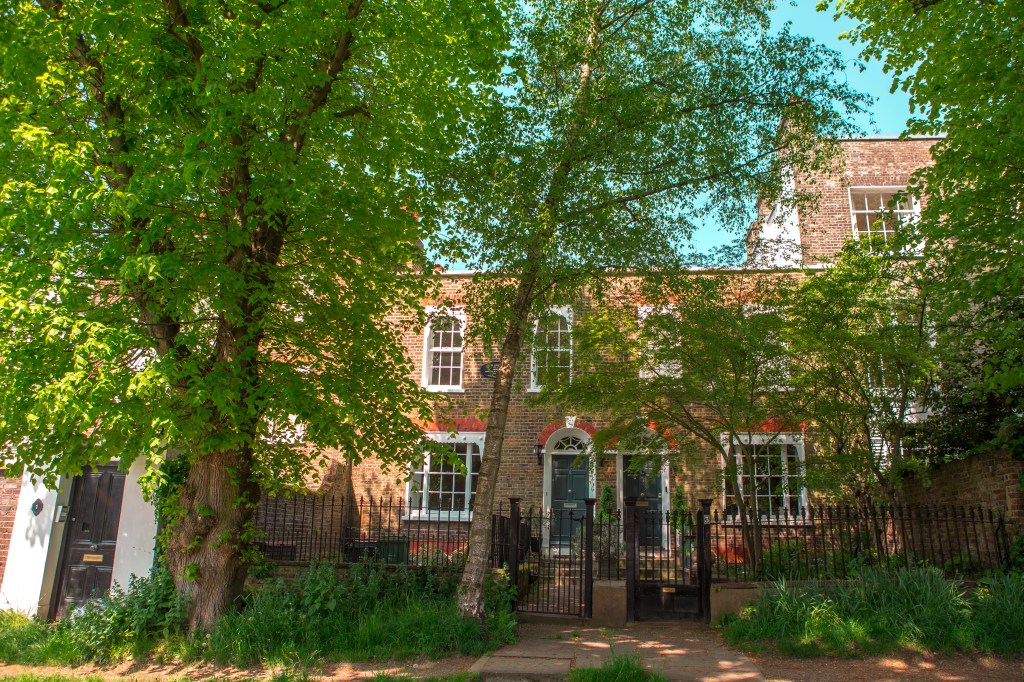
Born in East Bergholt, Suffolk, on June 11, 1776, he was drawn to Hampstead by its lush Heath greenery and its early Georgian and Regency architecture. It was here that he painted, sketched, drew, taught and lectured, declaring: “Here, Hampstead, let me take my everlasting rest.”
He first visited Hampstead when he was a student at the Royal Academy. Walking there from central London, he spoke of covering the “three miles from door to door … see nature, and unite a town and country life”. Its rich green verdant landscape reminded him of his family farm and home in Suffolk.
He spent the last 19 years of his life in Hampstead, painting the views that, he said, included “Child’s Hill, fields in Hendon, church spires in Harrow on the Hill, and even Windsor Castle!” He also sketched workhands labouring on the Heath, managing cows, sheep, horses, donkeys and dogs beneath ash, birch, elm, oak and fir trees around the ponds.
At about 450 feet above the city of London, Hampstead stood apart from the crowded, polluted city and offered a sanctuary for Constable’s family, especially his often-unwell wife, Maria. As he put it, “Hampstead is the lungs of London”, with “the finest views, unsurpassed in Europe, from Westminster to Gravesend, Kent, and the dome of St Paul’s” to paint.
Constable wrote that “every day in Hampstead makes me long for a walk”. He favoured the coarser landscape of the Heath to formal stiffly manicured city parks, which he saw as artificial rather than natural. As he said: “the gentleman’s park is my aversion. It’s not beauty because it’s not nature!”
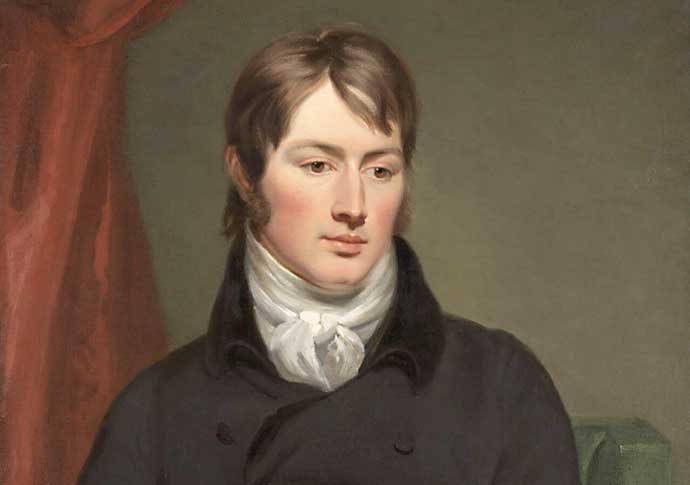
John Constable
He added: “My art is found under every hedge; in every lane – therefore no one thinks it’s worth picking…[But] the landscape is too large to go unnoticed…[and the] Canvas takes the place of God’s work; the landscape is God’s plan in eye; because since the Creation, no two days are alike, no two hours are alike. No two trees are alike. No two leaves are alike.” To communicate that selection of hue, he mixed “a thousand greens to capture the complexity of nature’s beauty.”
While living in Hampstead, Constable advanced some of his most investigational practises, including the cloud studies associated with his famous masterpiece The Hay Wain, 1821, in the National Gallery. Although the painting shows the River Stour and Willy Lott’s house, in Suffolk, it is believed to have been developed from sketches and drawings made near to Whitestone Pond. It was completed in the back garden shed of his Hampstead home, Lower Terrace.
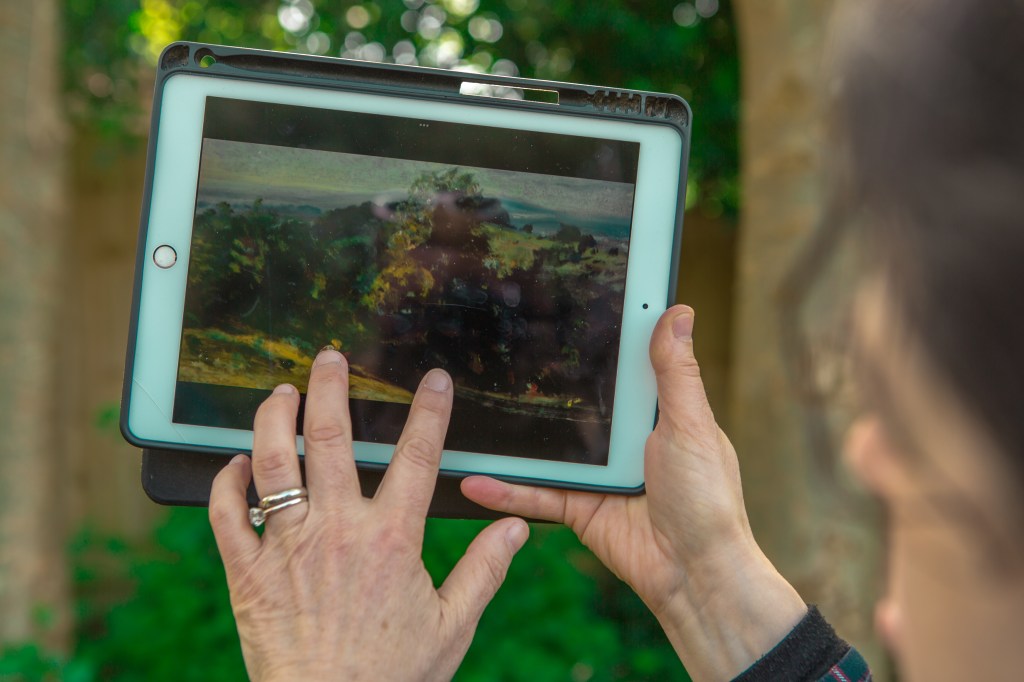
On the Heath and around Whitestone Pond, he studied light, atmosphere and movement with extraordinary liberty and self-determination, shifting direct observation into a new language of landscape painting. His oil paint sketches capture transitory rain showers, drifting vapours, fumes and coal-smoke unsettling the skyline.
These images still feel extraordinarily modern, not only for their wholesomeness of painterly-touch, but because they also seized the weather conditions, as lived experience. Hampstead gave him the visual platform he needed to seize the kaleidoscopic light, surging clouds, church towers in the distance and far-reaching outlooks analysing views across London, all of which sharpened his eye.
The Village streets, sweeping heathland and Constable’s actual painting viewpoints lets one see, feel and live the visual exchange between artist and location. Reminding us how Constable painted not only topography – en plein air, but also memory – back in his studio. Finding godliness and spiritual power deep in English landscape.
Walking where he Constable did is to see how Hampstead became both a safe haven and art studio: a place for family life and artistic experimentation. In Hampstead, the natural world continually charged his artistic imagination, making celebrating Constable’s 250th birthday here feels so significant.
He died in 1837 and is buried with his wife, Maria, and six of their seven their children, in their family tomb at St John’s Parish Church, Church Row, Hampstead.
Estelle Lovatt on marking Constable’s 250th birthday
Credit – Cristina Schek
This year we mark the 250th birthday of John Constable, the great British, Romantic Realist, landscape painter.
Born in East Bergholt, Suffolk, Constable later made Hampstead his home after falling in love with its lush green verdant setting and early Georgian and Regency architecture.
He first discovered the area whilst he was a young fine art student at the Royal Academy. Walking from central London to the Heath, he described the route as the “three miles from door to door [from central London to Hampstead]…see nature, and unite a town and country life”. Its spectacular verdant landscape reminded him of his family farm and Suffolk home.
Rising some 450 feet above the City of London, Hampstead offered great distance from the over-crowded, fog polluted, metropolis and became a relaxing, exhilarating, refuge for Constable, and his family. His wife, whose health was extremely fragile, benefitted from Hampstead, a spa destination.
He praised its fresh air, calling Hampstead “the lungs of London”. And admired “the finest views, unsurpassed in Europe, from Westminster to Gravesend, Kent, and the dome of St Paul’s”, which he painted, sketched and drew as one of the most lovely, spectacular, sights he found.
Constable spent the final 19 years of his life in Hampstead. Capturing views he said included “Childs Hill, fields in Hendon, church spires in Harrow on the Hill, and even Windsor Castle!”
He sketched farm labourers at work on the Heath tending their cows, sheep, horses, donkeys and dogs. Beneath ash, birch, elm, oak and fir trees growing beyond hedgerows, around the ponds.
In Hampstead, Constable developed some of his most experimental painting techniques, including cloud studies for his celebrated six-footer masterpiece, The Hay Wain, 1821 (at the National Gallery). Although the painting shows the River Stour and Willy Lott’s house it is believed he worked from sketches made by Whitestone Pond and completed this masterpiece canvas in the garden shed of his Hampstead home — not in Suffolk!
Constable loved Hampstead and felt a deep connection with the area. Writing how: “Every day in Hampstead makes me long for a walk”. He preferred the rugged landscape of the Heath to formal city parks, which he considered artificial, saying: “The gentleman’s park is my aversion. It’s not beauty because it’s not nature!”
He added: “My art is found under every hedge; in every lane – therefore no one thinks it’s worth picking…[But] the landscape is too large to go unnoticed…[and the] Canvas takes the place of God’s work; the landscape is God’s plan in eye; because since the Creation, no two days are alike, no two hours are alike. No two trees are alike. No two leaves are alike.”
He used “a thousand greens to capture the complexity of nature’s beauty.”
He said: “Here, Hampstead, let me take my everlasting rest.” Constable is buried with his wife, Maria, and six of their seven children, in the family tomb at Saint John’s Parish Church, Church Row, London NW3.
You can celebrate the great Old Master’s landmark birthday by following in his footsteps and joining my ‘Walk Constable’s Hampstead’ guided tour.
To visit the places where Constable lived, loved, worked and painted his magnificent paintings, under the effects of ‘Skying’ and ‘Constable’s Snow’, painted ‘alla prima’, ‘en plein air’ in Hampstead Village, London NW3, more than 200 years ago. You’ll be surprised what’s to discover… and might be inspired to pick up a paintbrush yourself too.
LONDON (AP) — David Hockney, a treasured British artist whose paintings of shimmering pools and colorful iPad drawings became icons of contemporary art, has died, his publicist said Friday. He was 88.
Over a seven-decade career, Hockney explored and reimagined classical portraiture, landscape painting and pop art, working in painting, collage, photography and digital drawing.
Later in life he returned to Europe, finding renewed inspiration in the wooded hills of his native county of Yorkshire and the fields and trees of France’s Normandy region. One of the most popular and critically lauded British artists of his generation, his works sold for record prices at auction.
Historian Simon Schama said it’s no mystery why the appeal of his work endures.
“His work is admired — loved is not too strong a word — by the millions who, worldwide, flock to see it because it presupposes an expectation of pleasure,” Schama wrote in an essay accompanying a 2025 Hockney exhibition in Paris.
Hockney’s publicist, Erica Bolton, said he died at his home in London on Thursday, less than a month short of his 89th birthday. She did not give a cause of death.
He is survived by his longtime partner, Jean-Pierre Gonçalves de Lima; his great-nephew and studio assistant, Richard Hockney; his brothers Philip and John; and numerous nieces, nephews, great-nieces and great-nephews.
Hockney was an icon of the swinging 60s
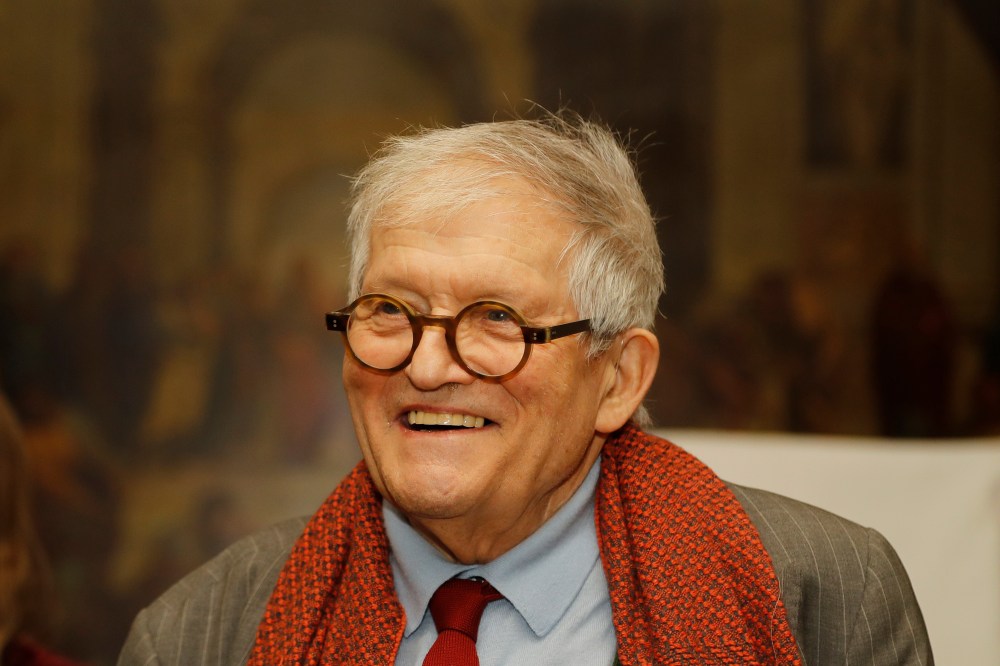
FILE – Artist David Hockney after unveiling the bottle design for the 2014 vintage wine of Château Mouton Rothschild in London, Friday, Feb. 3, 2017. (AP Photo/Frank Augstein, File)
With his trademark round glasses and bleached-blond hair, Hockney was a well-known figure in the swinging British and American art scenes of the 1960s, even before he reached the age of 30. His paintings were just as distinctive, many of them creating a dreamlike world of patterned light bouncing off water and windows, and human forms rendered in flattened, simplified shapes in matte acrylic paint.
“I’m excited every day,” he told the Los Angeles Times in 1979. “London has lots of dreary parts, but I never find anything dreary in Los Angeles.”
Hockney was born July 9, 1937, in Bradford, a large industrial city whose chief export was woolen textiles. He spent his first two decades there before going to London’s Royal College of Art. He made an impact even before his graduation, and art dealer John Kasmin took him into his stable of artists in 1961.
His artistic influences ranged widely, including Renaissance portraits, 18th-century English artist William Hogarth’s satirical drawings, 19th-century English painter J.M.W. Turner’s landscapes, Pablo Picasso’s experiments in Cubism and 20th-century American pop art.
He shared with other pop artists an interest in the polished surface of modern life. And, like Andy Warhol with his Brillo boxes and Campbell’s soup cans, Hockney occasionally incorporated advertising labels, such as a British Typhoo Tea box used in his 1961 “Tea Painting in an Illusionistic Style.”
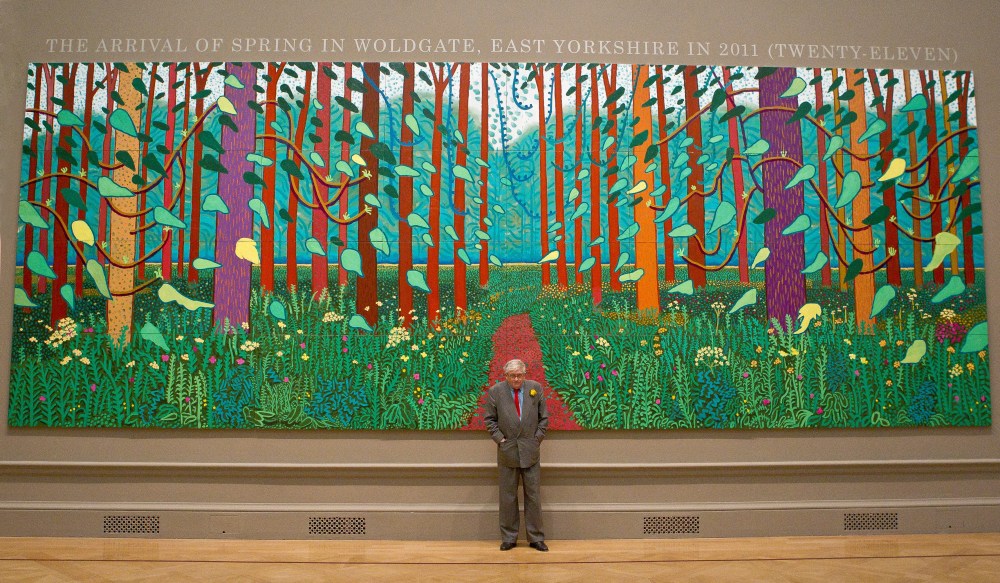
FILE – British artist David Hockney stands before one of his paintings of the East Yorkshire landscape at The Royal Academy of Arts in Piccadilly, London, Monday, Jan. 16, 2012, ahead of his exhibition called ‘A Bigger Picture’. (AP Photo/Joel Ryan)
He saw success early in his career
He told The New York Times in 1964 that he enjoyed the burgeoning pop art scene in New York but wasn’t sure he was part of it.
“I’m just an ordinary artist,” he said. “I do admire American pop — in fact it seems that everything fresh-looking and vital in England these days has been coming from the U.S.”
Nonetheless, he said in 1995 that he still considered himself “very much an artist in the English tradition.”
Hockney, who was out as a gay man long before it was common, explored erotic themes, giving youthful male bodies the same tender scrutiny that artists had been giving the female nude for centuries.
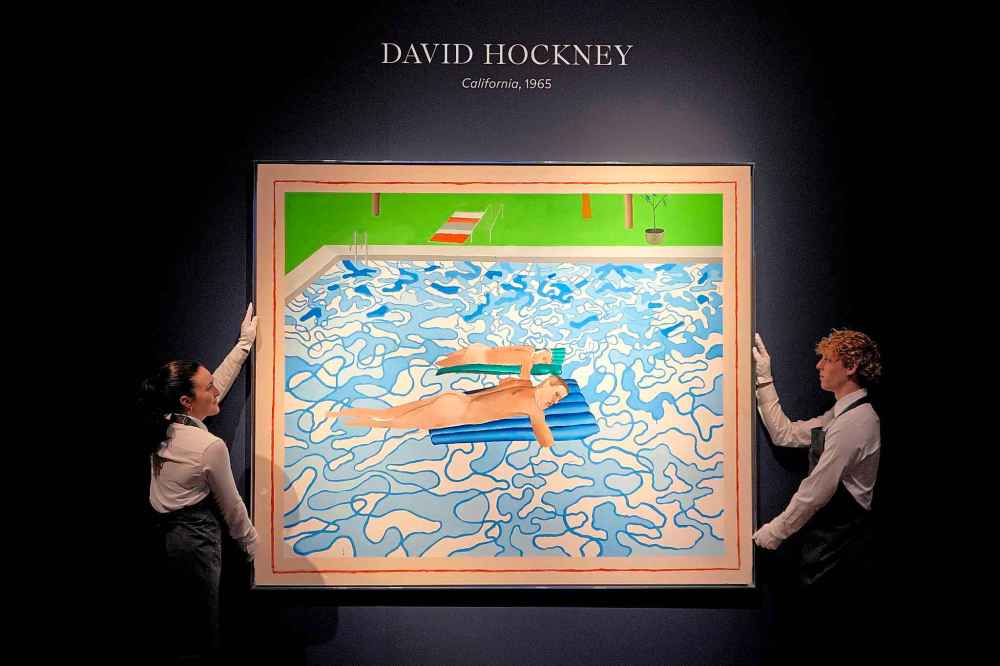
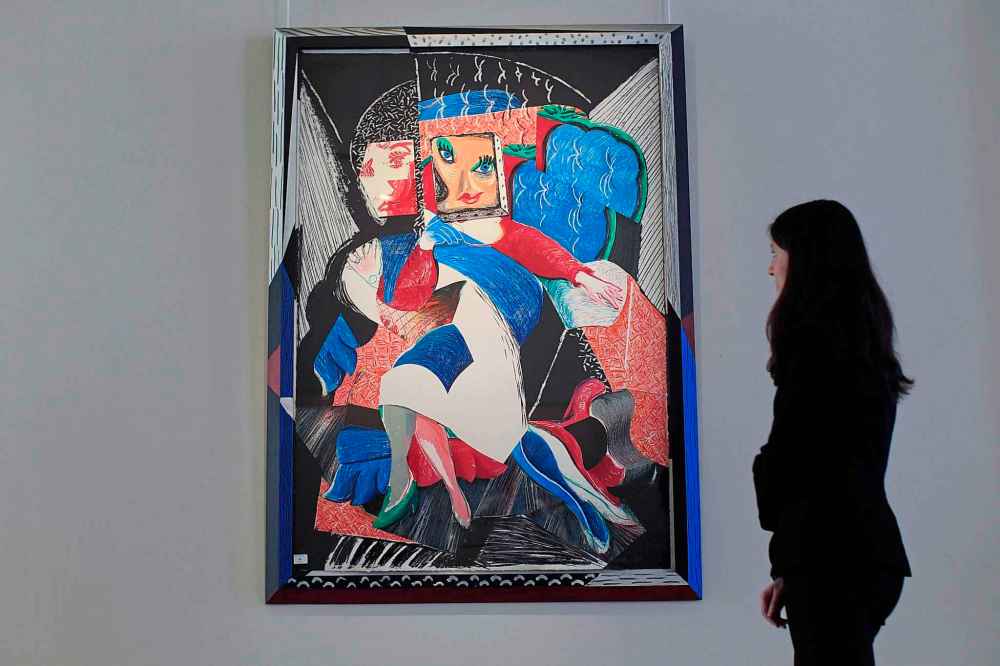
A painting by David Hockney called California is displayed at Christie’s auction rooms in London, Friday, March 1, 2024. (AP Photo/Kirsty Wigglesworth)
Early works like “We Two Boys Together Clinging” and “Two Men in a Shower” celebrated gay relationships when homosexuality was still illegal in Britain.
Early in his career, two of his drawings were bought for the Museum of Modern Art in New York.
“The moment I first sold pictures to earn a living, I felt rich. I’ve been rich ever since,” he told The Associated Press in 1995. “I didn’t have much money, but I did what I wanted. … You are a rich man if you do the things you want to do.”
In 2018, his 1972 painting “Portrait of an Artist (Pool with Two Figures)” sold at a Christie’s auction for $90.3 million, at the time a record for a living artist.
While many of his best-known paintings had American scenes, he also tackled British subjects. He immortalized his parents in several portraits and his friends Ossie Clark and Celia Birtwell in “Mr. and Mrs. Clark and Percy,” a 1971 portrait voted one of Britain’s greatest paintings in a 2005 BBC poll.
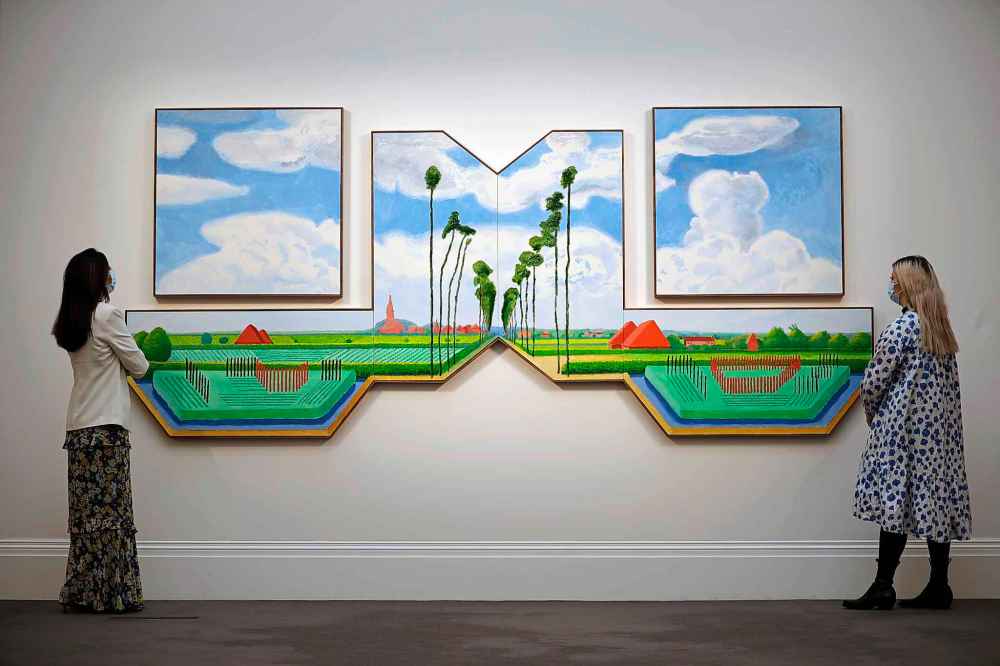
Staff members pose for photographs with British artist David Hockney’s triptych “Tall Dutch Trees After Hobbema (Useful Knowledge) 2017”, at the premises of Sotheby’s auction house in London, Monday, March 22, 2021. (AP Photo/Matt Dunham)
Hockney’s work went beyond drawing and painting
Like many traditional artists, he considering drawing a fundamental skill and lamented that it wasn’t taught as rigorously as it used to be.
“Human beings are the most interesting things we see, so they’re the hardest to draw,” he said in a 1996 AP interview.
Hockney also embraced other media, including printmaking, photo collage and video. He contributed costume and set designs for the theater and opera, including a celebrated production of “Tristan und Isolde” first staged in 1987 at the Los Angeles Opera.
When he took up photography, he fused genres, assembling individual photos into elaborate collages like “Pearblossom Highway, 11-18th April, 1986,” built up of individual views of a desert highway intersection.
Bonhams’ employee Ana Paiva from Portugal poses for photographs beside David Hockney’s “Moving Focus – An Image of Celia” at the auction house’s premises in London, Monday, April 18, 2011. (AP Photo/Matt Dunham)
“My photographer friends said it was a painting,” Hockney told the AP in 2001. “I said it’s a photograph; I used a camera.”
Later he began to draw on iPads, which became his favorite tool.
In the early 2000s, he looked afresh at the fields and forests of Yorkshire in a series of landscape paintings that combined bold color with minute attention to the texture of snow on a hillside or a blossom on a hawthorn hedge. They featured in a 2017 exhibition at Tate Britain in London that was visited by half a million people and moved to the Pompidou Center in Paris and the Metropolitan Museum of Art in New York.
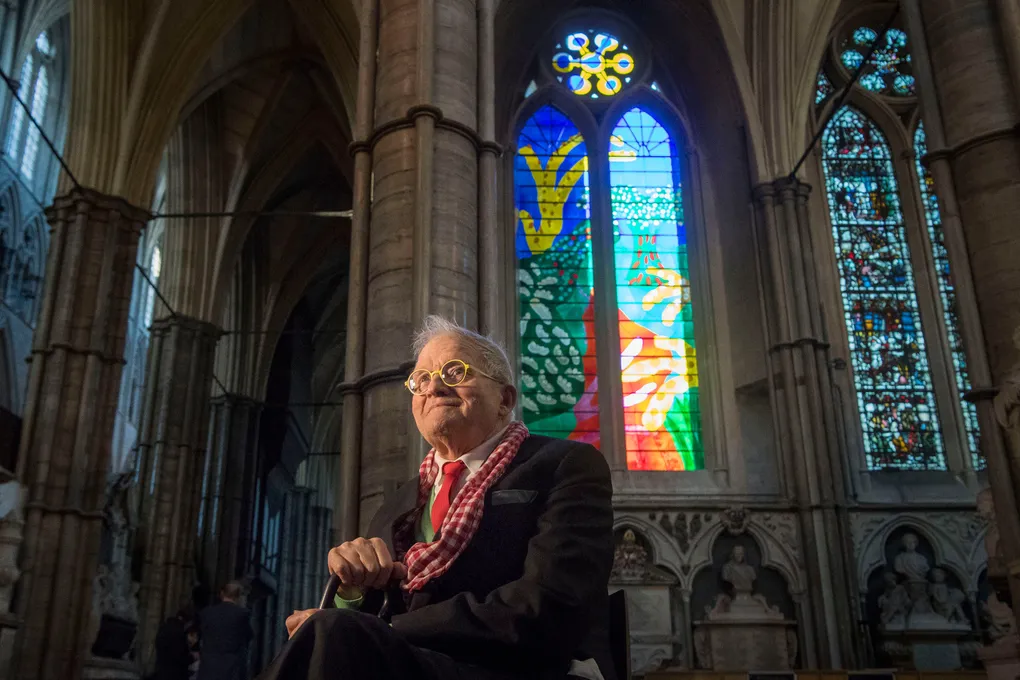
Hockney used the English landscape for inspiration in his design for a stained-glass window installed at Westminster Abbey in 2018 to celebrate the long reign of Queen Elizabeth II.
King Charles III paid tribute to “one of life’s true originals” as he mourned “a man whose irrepressible charm, talent and constant innovation will be most sorely missed, but whose dazzling creativity lives on in galleries and museums around the world.”
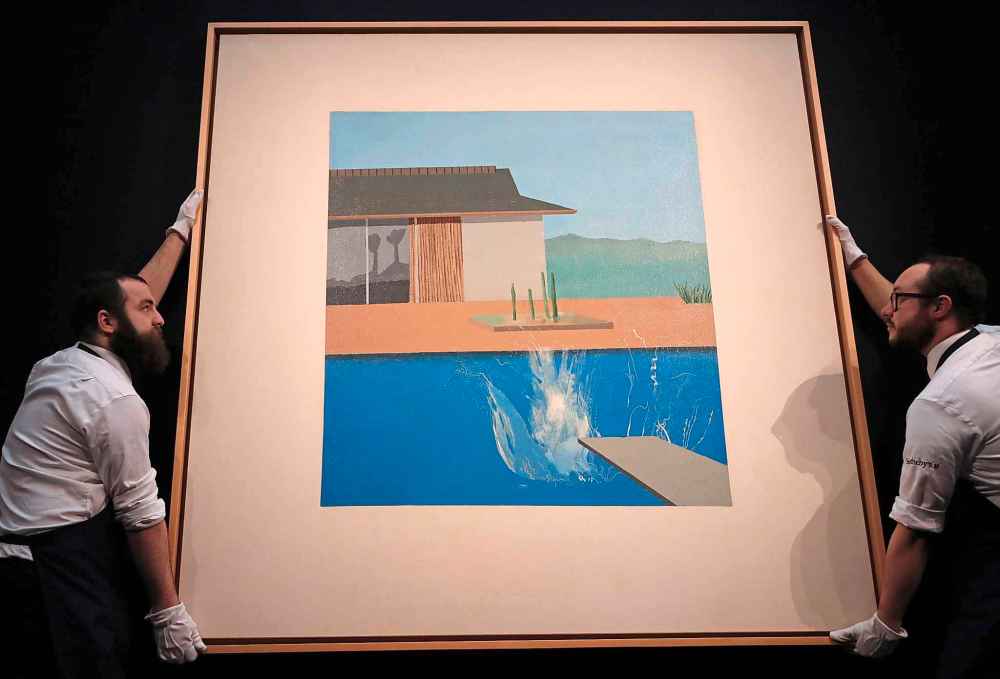
Two Sotheby’s employees adjust David Hockney’s painting ‘The Splash’ at Sotheby’s contemporary Art sale preview in London, Friday, Feb. 7, 2020. (AP Photo/Frank Augstein)
He worked right up until his death
In 2019, he moved to Normandy, where during the 2020 coronavirus lockdown he produced joyous iPad drawings of springtime for his friends. His message — “Do remember they can’t cancel the spring” — was emblazoned in neon across the Fondation Louis Vuitton in Paris when it hosted a huge Hockney exhibition that opened in April 2025.
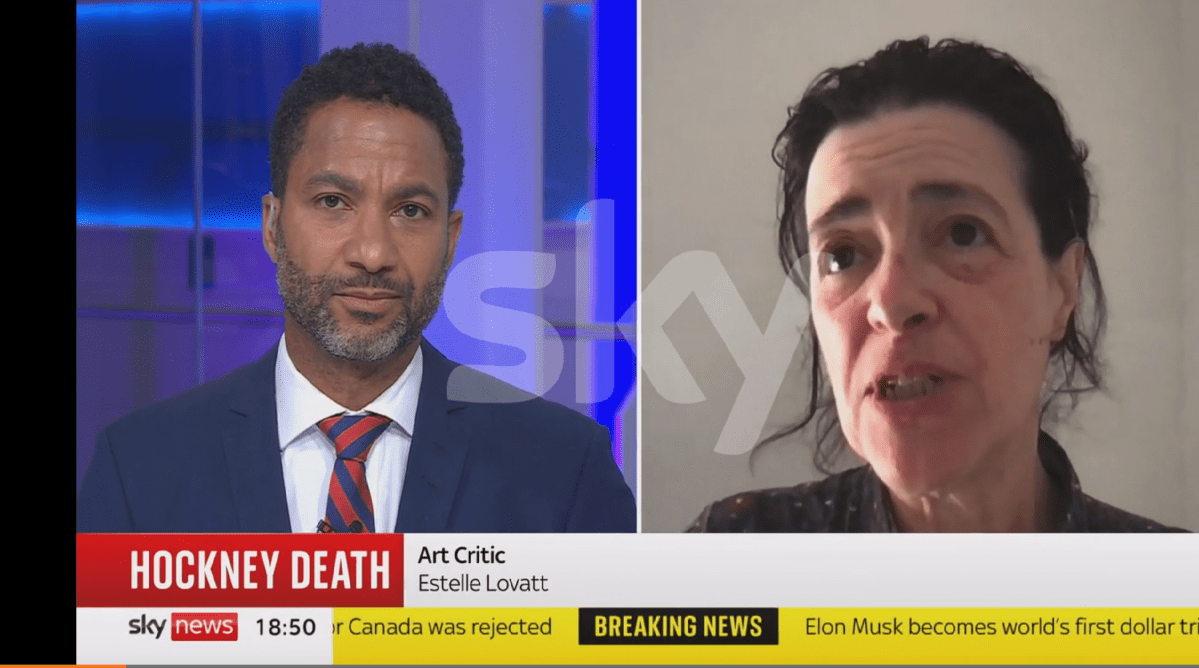
Art critic Estelle Lovatt said Hockney “changed how we see the world.”
“He was one of the first artists to use a fax machine,” she told the AP. “He was one of the first artists to use the Polaroid camera to make collages. He was one of the first artists to use really, really vibrant colors.”
An unrepentant cigarette smoker who railed against government anti-smoking rules, Hockney complained when a poster for the 2025 exhibition was banned from the Paris Metro because it showed him holding a cigarette.
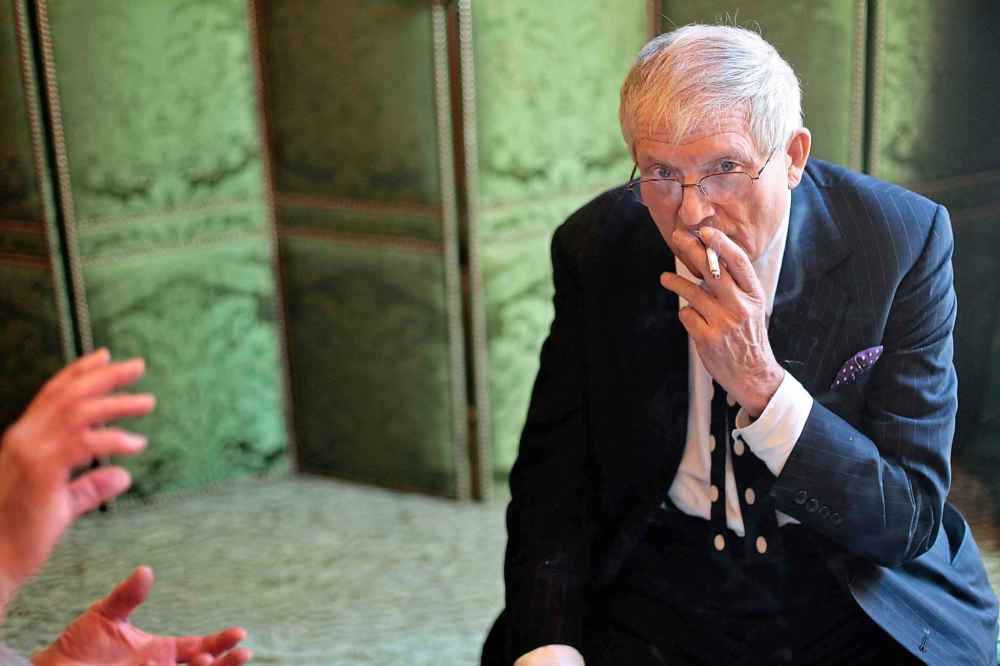
British artist David Hockney is seen at the Pierre Berge foundation, in Paris, Monday Oct. 18, 2010. (AP Photo/Thibault Camus)
The announcement of his death from his publicist noted that Hockney was “a committed life-long and defiant smoker, expressing the pleasure in life it brought him. … He smoked up to the end.”
Hockney had a minor stroke in 2012 and was increasingly deaf in later years — something he said improved his visual perception.