David Hockney, iconic British artist known for his colorful landscapes and pool scenes, dies at 88 | PBS News, USA

LONDON (AP) — David Hockney, a treasured British artist whose paintings of shimmering pools and colorful iPad drawings became icons of contemporary art, has died, his publicist said Friday. He was 88.

Over a seven-decade career, Hockney explored and reimagined classical portraiture, landscape painting and pop art, working in painting, collage, photography and digital drawing.

Hockney was born in the north of England but lived much of his life in Southern California, making its sun-drenched suburban views a major motif.

WATCH: David Hockney thinks you should take a longer look at life

Later in life he returned to Europe, finding renewed inspiration in the wooded hills of his native county of Yorkshire and the fields and trees of France’s Normandy region. One of the most popular and critically lauded British artists of his generation, his works sold for record prices at auction.

Historian Simon Schama said it’s no mystery why his work is so enduringly appealing.

“His work is admired — loved is not too strong a word — by the millions who, worldwide, flock to see it because it presupposes an expectation of pleasure,” Schama wrote in an essay accompanying a 2025 Hockney exhibition in Paris.

WATCH: Art exhibit ‘For Dear Life’ shows new perspectives on disability and medicine in the U.S.

Hockney’s publicist, Erica Bolton, said he died at his home in London on Thursday, less than a month short of his 89th birthday. She did not give a cause of death.

He is survived by his longtime partner Jean-Pierre Gonçalves de Lima; his great-nephew and studio assistant, Richard Hockney; his brothers Philip and John; and numerous nieces, nephews, great-nieces and great-nephews.

Hockney was an icon of the swinging 60s

With his trademark round glasses and bleached-blond hair, Hockney was a well-known figure in the swinging British and American art scenes of the 1960s, even before he reached the age of 30. His paintings were just as distinctive, many of them creating a dreamlike world of patterned light bouncing off water and windows, and human forms rendered in flattened, simplified shapes in matte acrylic paint.

“I’m excited every day,” he told the Los Angeles Times in 1979. “London has lots of dreary parts but I never find anything dreary in Los Angeles.”

WATCH: David Hockney continues prodigious picture-making career by adopting new tech

Hockney was born July 9, 1937, in Bradford, a large industrial city whose chief export was woolen textiles. He spent his first two decades there before going to London’s Royal College of Art. He made an impact even before his graduation, and art dealer John Kasmin took him into his stable of artists in 1961.

His artistic influences ranged widely, including Renaissance portraits, 18th-century English artist William Hogarth’s satirical drawings, 19th-century English painter J.M.W. Turner’s landscapes, Pablo Picasso’s experiments in Cubism and 20th-century American pop art.

He shared with other pop artists an interest in the polished surface of modern life. And, like Andy Warhol with his Brillo boxes and Campbell’s soup cans, Hockney occasionally incorporated advertising labels, such as a British Typhoo Tea box used in his 1961 “Tea Painting in an Illusionistic Style.”

He saw success early in his career

He told The New York Times in 1964 that he enjoyed the burgeoning pop art scene in New York but wasn’t sure he was part of it.

“I’m just an ordinary artist,” he said. “I do admire American pop — in fact it seems that everything fresh-looking and vital in England these days has been coming from the U.S.”

WATCH: David Hockney thinks you should take a longer look at life

Nonetheless, he said in 1995 that he still considered himself “very much an artist in the English tradition.”

Hockney, who was out as a gay man long before it was common, explored erotic themes, giving youthful male bodies the same tender scrutiny that artists had been giving the female nude for centuries.

Early works like “We Two Boys Together Clinging” and “Two Men in a Shower” celebrated gay relationships when homosexuality was still illegal in Britain.

Early in his career, two of his drawings were bought for the Museum of Modern Art in New York.

“The moment I first sold pictures to earn a living, I felt rich. I’ve been rich ever since,” he told The Associated Press in 1995. “I didn’t have much money but I did what I wanted. … You are a rich man if you do the things you want to do.”

In 2018, his 1972 painting “Portrait of an Artist (Pool with Two Figures)” sold at a Christie’s auction for $90.3 million, at the time a record for a living artist.

While many of his best-known paintings had American scenes, he also tackled British subjects. He immortalized his parents in several portraits and his friends Ossie Clark and Celia Birtwell in “Mr. and Mrs. Clark and Percy,” a 1971 portrait voted one of Britain’s greatest paintings in a 2005 BBC poll.

Hockney’s work went beyond drawing and painting

Like many traditional artists, he considering drawing a fundamental skill and lamented that it wasn’t taught as rigorously as it used to be.

“Human beings are the most interesting things we see, so they’re the hardest to draw,” he said in a 1996 AP interview.

Hockney also embraced other media, including printmaking, photo collage and video. He contributed costume and set designs for the theater and opera, including a celebrated production of “Tristan und Isolde” first staged in 1987 at the Los Angeles Opera.

When he took up photography, he fused genres, assembling individual photos into elaborate collages like “Pearblossom Highway, 11-18th April, 1986,” built up of individual views of a desert highway intersection.

“My photographer friends said it was a painting,” Hockney told the AP in 2001. “I said it’s a photograph; I used a camera.”

Later he began to draw on iPads, which became his favorite tool.

In the early 2000s, he looked afresh at the fields and forests of Yorkshire in a series of landscape paintings that combined bold color with minute attention to the texture of snow on a hillside or a blossom on a hawthorn hedge. They featured in a 2017 exhibition at Tate Britain in London that was visited by half a million people and moved to the Pompidou Center in Paris and the Metropolitan Museum of Art in New York.

Hockney used the English landscape for inspiration in his design for a stained-glass window installed at Westminster Abbey in 2018 to celebrate the long reign of Queen Elizabeth II.

He worked right up until his death

In 2019, he moved to Normandy, where during the 2020 coronavirus lockdown he produced joyous iPad drawings of springtime for his friends. His message — “Do remember they can’t cancel the spring” — was emblazoned in neon across the Fondation Louis Vuitton in Paris when it hosted a huge Hockney exhibition that opened in April 2025.

Art critic Estelle Lovatt said Hockney “changed how we see the world.”

“He was one of the first artists to use a fax machine,” she told the AP. “He was one of the first artists to use the Polaroid camera to make collages. He was one of the first artists to use really, really vibrant colors.”

An unrepentant cigarette smoker who railed against government anti-smoking rules, Hockney complained when a poster for the 2025 exhibition was banned from the Paris Metro because it showed him holding a cigarette.

The announcement of his death from his publicist noted that Hockney was “a committed life-long and defiant smoker, expressing the pleasure in life it brought him. … He smoked up to the end.”

Hockney had a minor stroke in 2012 and was increasingly deaf in later years — something he said improved his visual perception.

“If you lose one sense, you gain other senses, and I feel I could see space clearer,” he told the AP in 2017.

He never stopped working.

“It’s my work that keeps me young,” Hockney told the Sun newspaper in 2017. “I’ve been a professional painter for 60 years. Sixty years of getting up every day and doing exactly what I want to do.”

Associated Press journalist Mustakim Hasnath contributed to this report.
Source: https://www.pbs.org/newshour/world/david-hockney-iconic-british-artist-known-for-his-colorful-landscapes-and-pool-scenes-dies-at-88

David Hockney, Iconic British Artist Known for Colorful Landscapes, Dies at 88 | KQED

An icon of the swinging 1960s, Hockney had recently found inspiration in digital art with an iPad.


A man in a suit leans on a cane in front of a painting of trees

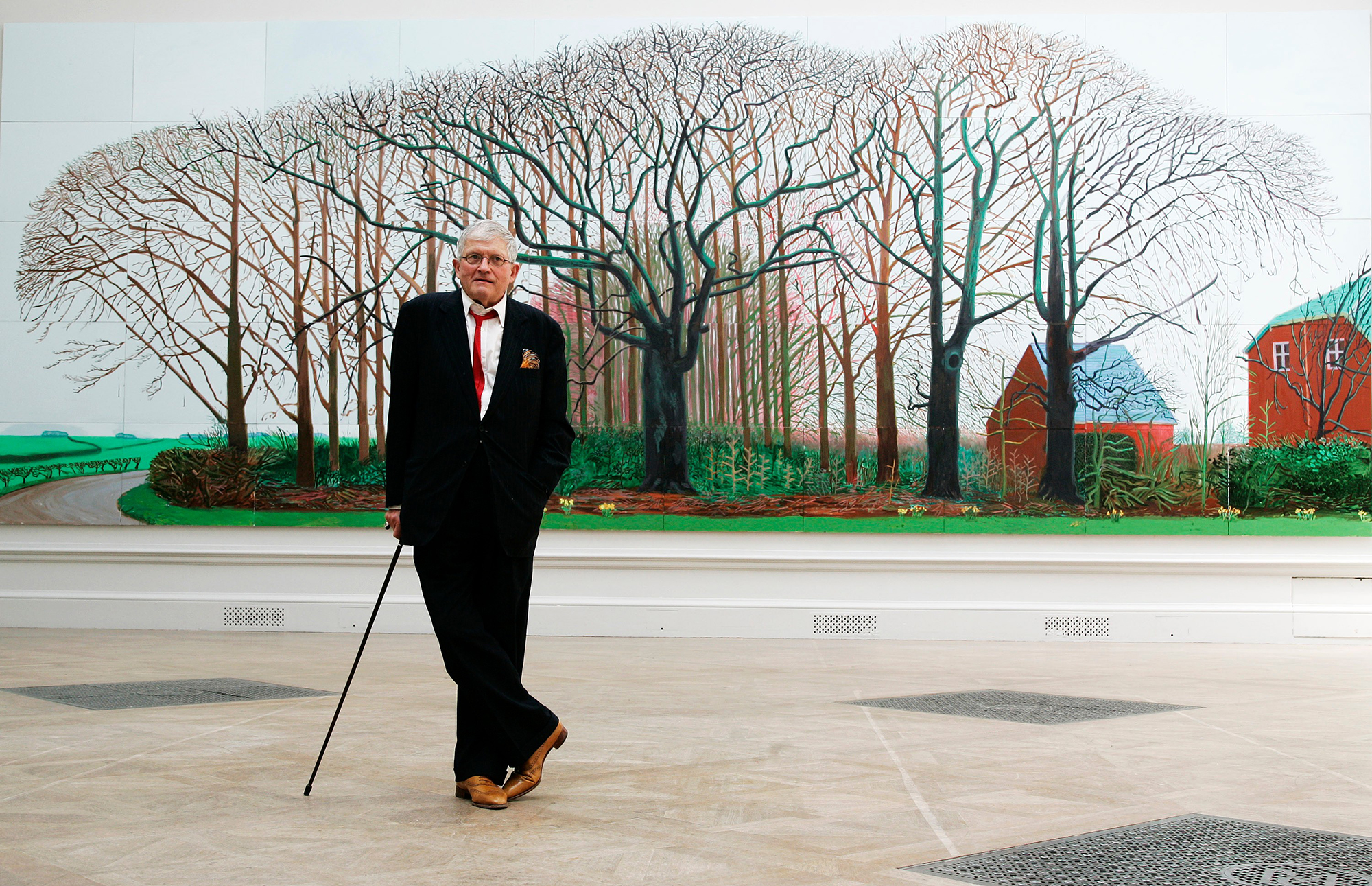
British artist David Hockney poses as he unveils his painting ‘Bigger Trees Near Water’, the largest painting ever shown at the Royal Academy’s Summer Exhibition, London, Friday, May 25, 2007.  (AP Photo/Sang Tan)

David Hockney, a treasured British artist whose paintings of shimmering pools and colorful iPad drawings became icons of contemporary art, has died, his publicist said Friday. He was 88.

Over a seven-decade career, Hockney explored and reimagined classical portraiture, landscape painting and pop art, working in painting, collage, photography and digital drawing.

Hockney was born in the north of England but lived much of his life in Southern California, making its sun-drenched suburban views a major motif.

Later in life he returned to Europe, finding renewed inspiration in the wooded hills of his native county of Yorkshire and the fields and trees of France’s Normandy region. One of the most popular and critically lauded British artists of his generation, his works sold for record prices at auction.

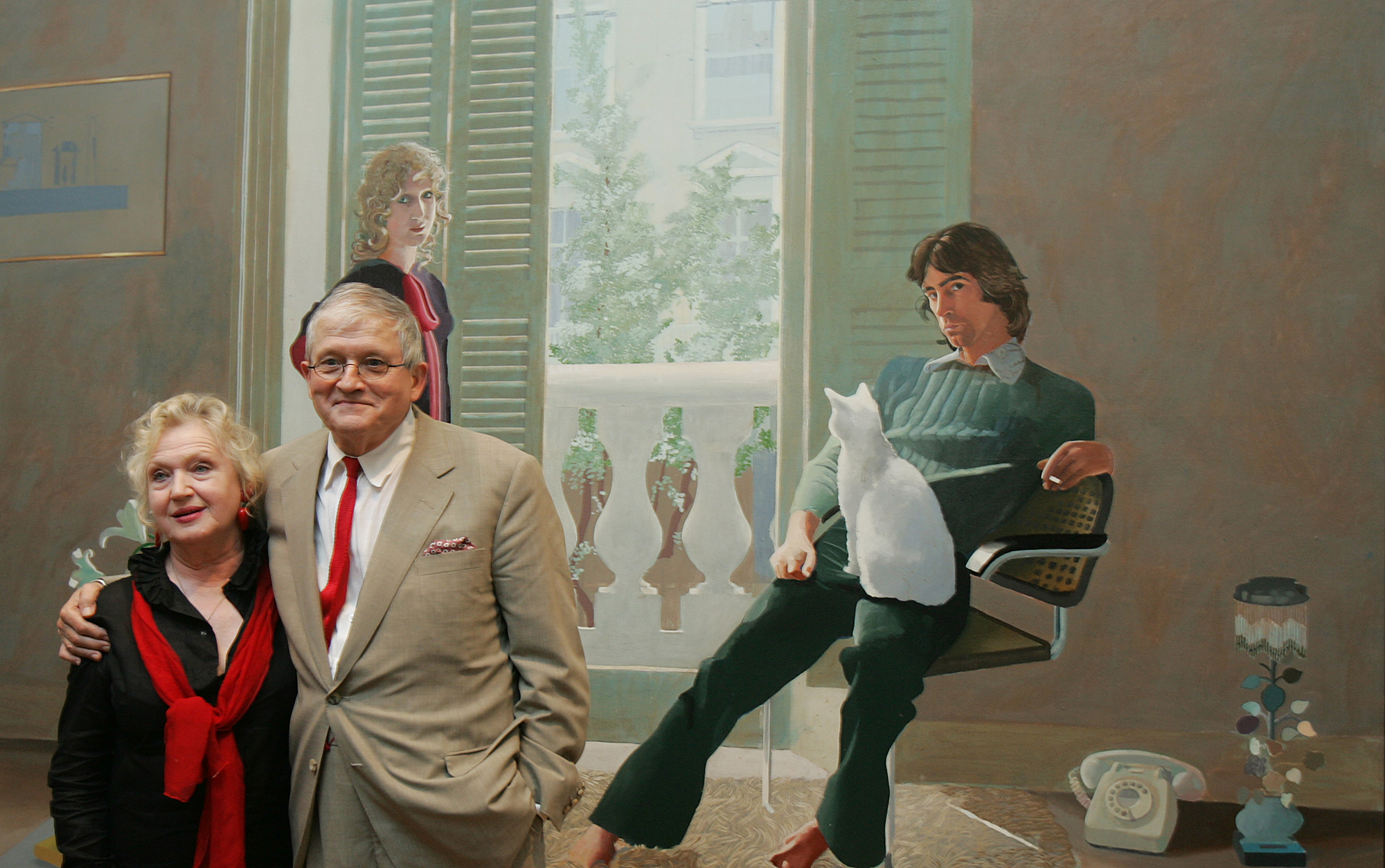
British artist David Hockney, stands next to his friend and model Celia Birtwell, in front of one of his most famous works ‘ Mr and Mrs Clark and Percy’ at the National Portrait Gallery in London, Wednesday Oct. 11, 2006.
 (AP Photo/Alastair Grant)

Historian Simon Schama said it’s no mystery why his work is so enduringly appealing.

“His work is admired — loved is not too strong a word — by the millions who, worldwide, flock to see it because it presupposes an expectation of pleasure,” Schama wrote in an essay accompanying a 2025 Hockney exhibition in Paris.

Become a KQED Sponsor

Hockney’s publicist, Erica Bolton, said he died at his home in London on Thursday, less than a month short of his 89th birthday. She did not give a cause of death.

He is survived by his longtime partner Jean-Pierre Gonçalves de Lima; his great-nephew and studio assistant, Richard Hockney; his brothers Philip and John; and numerous nieces, nephews, great-nieces and great-nephews.

Hockney was an icon of the swinging 60s

With his trademark round glasses and bleached-blond hair, Hockney was a well-known figure in the swinging British and American art scenes of the 1960s, even before he reached the age of 30. His paintings were just as distinctive, many of them creating a dreamlike world of patterned light bouncing off water and windows, and human forms rendered in flattened, simplified shapes in matte acrylic paint.

“I’m excited every day,” he told the Los Angeles Times in 1979. “London has lots of dreary parts but I never find anything dreary in Los Angeles.”

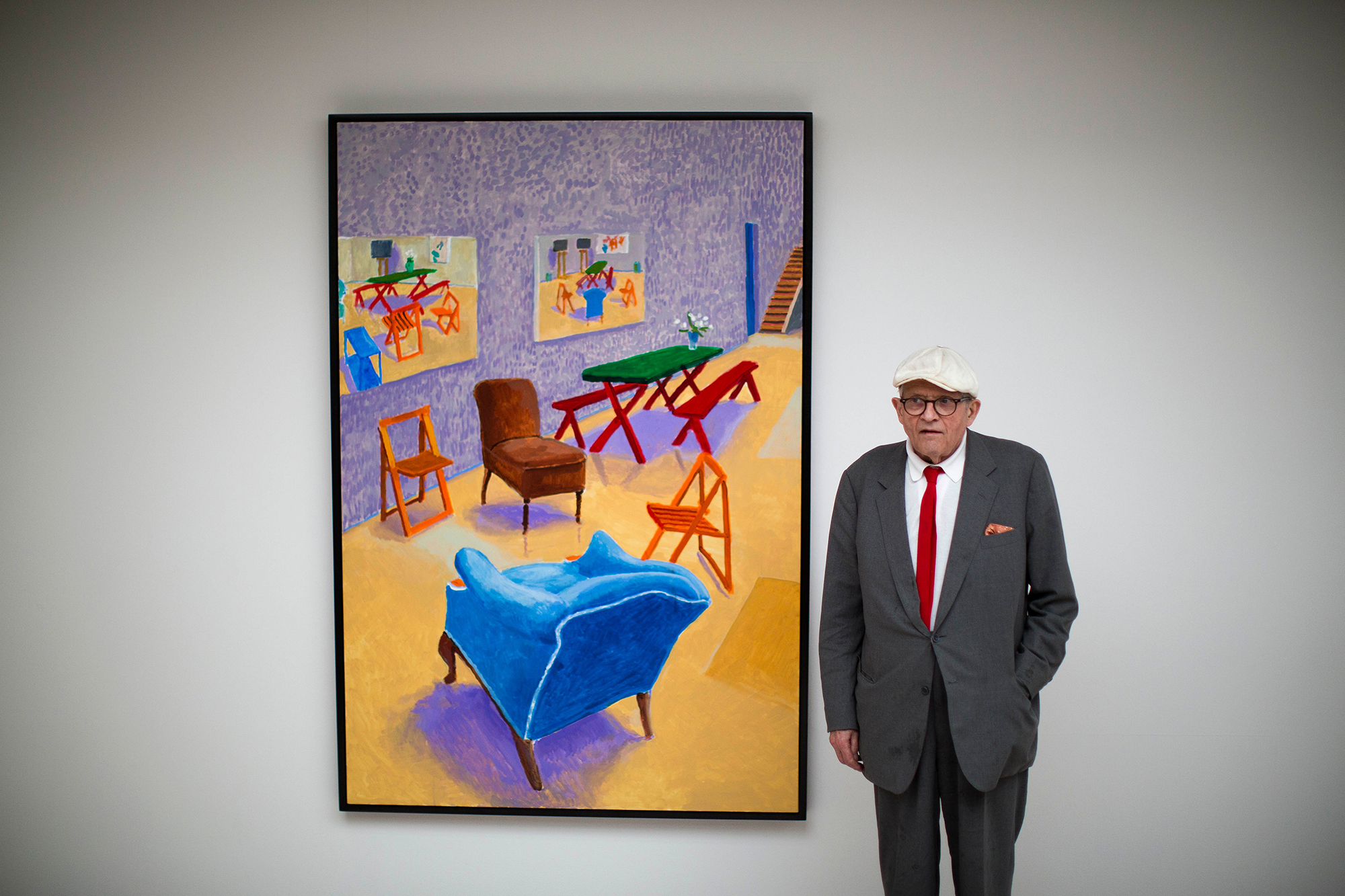
British artist David Hockney poses for photographers in front of his acrylic on canvas “Studio Interior #4” which features as part of the “David Hockney Painting and Photography” exhibition at the Annely Juda Fine Art gallery in London, Thursday, May 14, 2015. (AP Photo/Matt Dunham)

Hockney was born July 9, 1937, in Bradford, a large industrial city whose chief export was woolen textiles. He spent his first two decades there before going to London’s Royal College of Art. He made an impact even before his graduation, and art dealer John Kasmin took him into his stable of artists in 1961.

His artistic influences ranged widely, including Renaissance portraits, 18th-century English artist William Hogarth’s satirical drawings, 19th-century English painter J.M.W. Turner’s landscapes, Pablo Picasso’s experiments in Cubism and 20th-century American pop art.

He shared with other pop artists an interest in the polished surface of modern life. And, like Andy Warhol with his Brillo boxes and Campbell’s soup cans, Hockney occasionally incorporated advertising labels, such as a British Typhoo Tea box used in his 1961 “Tea Painting in an Illusionistic Style.”

He saw success early in his career

He told The New York Times in 1964 that he enjoyed the burgeoning pop art scene in New York but wasn’t sure he was part of it.

“I’m just an ordinary artist,” he said. “I do admire American pop — in fact it seems that everything fresh-looking and vital in England these days has been coming from the U.S.”

Nonetheless, he said in 1995 that he still considered himself “very much an artist in the English tradition.”

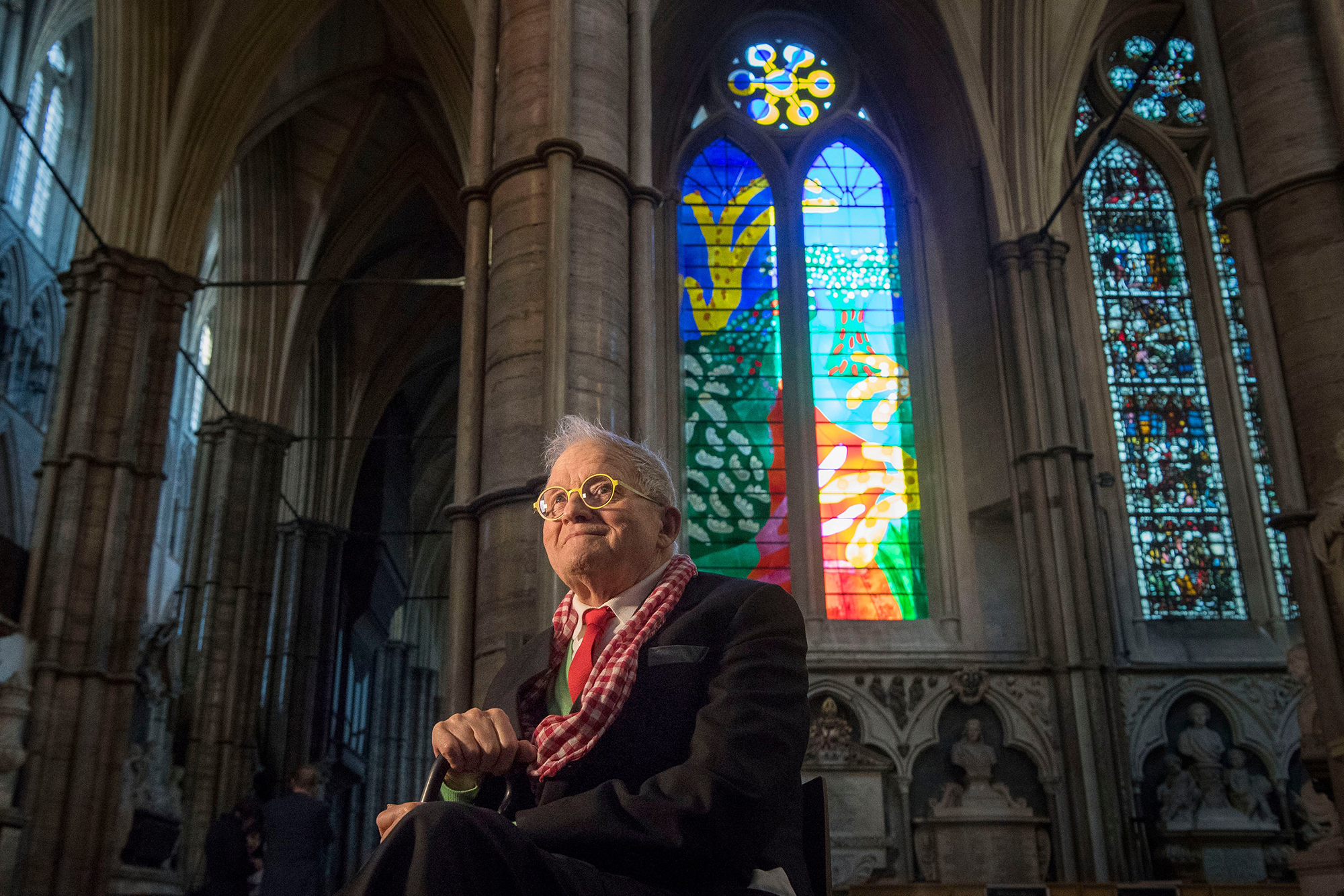
British artist David Hockney sits in front of The Queen’s Window, a new stained glass window at Westminster Abbey, London, designed by David Hockney and revealed for the first time on Wednesday Sept. 26, 2018. (Victoria Jones/Pool via AP)

Hockney, who was out as a gay man long before it was common, explored erotic themes, giving youthful male bodies the same tender scrutiny that artists had been giving the female nude for centuries.

Early works like “We Two Boys Together Clinging” and “Two Men in a Shower” celebrated gay relationships when homosexuality was still illegal in Britain.

Early in his career, two of his drawings were bought for the Museum of Modern Art in New York.

“The moment I first sold pictures to earn a living, I felt rich. I’ve been rich ever since,” he told the Associated Press in 1995. “I didn’t have much money but I did what I wanted. … You are a rich man if you do the things you want to do.”David Hockney, Frank Gehry Adopt the Arts at Two East Palo Alto Schools

In 2018, his 1972 painting “Portrait of an Artist (Pool with Two Figures)” sold at a Christie’s auction for $90.3 million, at the time a record for a living artist.

While many of his best-known paintings had American scenes, he also tackled British subjects. He immortalized his parents in several portraits and his friends Ossie Clark and Celia Birtwell in “Mr. and Mrs. Clark and Percy,” a 1971 portrait voted one of Britain’s greatest paintings in a 2005 BBC poll.

Hockney’s work went beyond drawing and painting

Like many traditional artists, he considering drawing a fundamental skill and lamented that it wasn’t taught as rigorously as it used to be.

“Human beings are the most interesting things we see, so they’re the hardest to draw,” he said in a 1996 AP interview.

Hockney also embraced other media, including printmaking, photo collage and video. He contributed costume and set designs for the theater and opera, including a celebrated production of Tristan und Isolde first staged in 1987 at the Los Angeles Opera.

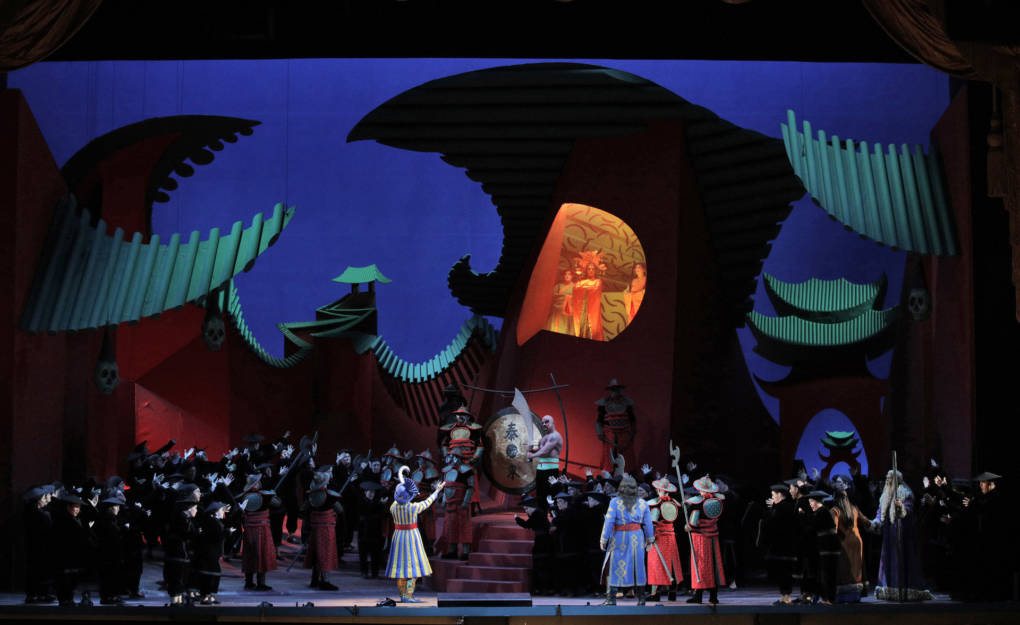
David Hockney's set design for Act I of SF Opera's "Turandot." In Hockney’s 1993 book "That’s the Way I See It," he wrote "I had seen many productions, most of them kitsch beyond belief, overdone chinoiserie and too many dragons… For the first scene, the city of Peking, I suggested that we take the dragons away and put them into the roofs, in forms that felt like dragons, without specifically looking like them, thus evoking the grotesqueness of the city."
David Hockney’s set design for Act I of Puccini’s ‘Turandot’ at SF Opera, as revived in 2017.  (Photo: Courtesy of Cory Weaver)

When he took up photography, he fused genres, assembling individual photos into elaborate collages like Pearblossom Highway, 11-18th April, 1986, built up of individual views of a desert highway intersection.

“My photographer friends said it was a painting,” Hockney told the AP in 2001. “I said it’s a photograph; I used a camera.”

Source: https://www.kqed.org/arts/13990732/david-hockney-dies-at-88

David Hockney, iconic British artist known for his colorful landscapes and pool scenes, dies at 88

LONDON (AP) — David Hockney, a treasured British artist whose paintings of shimmering pools and colorful iPad drawings became icons of contemporary art, has died, his publicist said Friday. He was 88.

Over a seven-decade career, Hockney explored and reimagined classical portraiture, landscape painting and pop art, working in painting, collage, photography and digital drawing.

Hockney was born in the north of England but lived much of his life in Southern California, making its sun-drenched suburban views a major motif.

Later in life he returned to Europe, finding renewed inspiration in the wooded hills of his native county of Yorkshire and the fields and trees of France’s Normandy region. One of the most popular and critically lauded British artists of his generation, his works sold for record prices at auction.

Historian Simon Schama said it’s no mystery why the appeal of his work endures.

“His work is admired — loved is not too strong a word — by the millions who, worldwide, flock to see it because it presupposes an expectation of pleasure,” Schama wrote in an essay accompanying a 2025 Hockney exhibition in Paris.

Hockney’s publicist, Erica Bolton, said he died at his home in London on Thursday, less than a month short of his 89th birthday. She did not give a cause of death.

He is survived by his longtime partner, Jean-Pierre Gonçalves de Lima; his great-nephew and studio assistant, Richard Hockney; his brothers Philip and John; and numerous nieces, nephews, great-nieces and great-nephews.

Hockney was an icon of the swinging 60s

With his trademark round glasses and bleached-blond hair, Hockney was a well-known figure in the swinging British and American art scenes of the 1960s, even before he reached the age of 30. His paintings were just as distinctive, many of them creating a dreamlike world of patterned light bouncing off water and windows, and human forms rendered in flattened, simplified shapes in matte acrylic paint.

“I’m excited every day,” he told the Los Angeles Times in 1979. “London has lots of dreary parts, but I never find anything dreary in Los Angeles.”

Hockney was born July 9, 1937, in Bradford, a large industrial city whose chief export was woolen textiles. He spent his first two decades there before going to London’s Royal College of Art. He made an impact even before his graduation, and art dealer John Kasmin took him into his stable of artists in 1961.

His artistic influences ranged widely, including Renaissance portraits, 18th-century English artist William Hogarth’s satirical drawings, 19th-century English painter J.M.W. Turner’s landscapes, Pablo Picasso’s experiments in Cubism and 20th-century American pop art.

He shared with other pop artists an interest in the polished surface of modern life. And, like Andy Warhol with his Brillo boxes and Campbell’s soup cans, Hockney occasionally incorporated advertising labels, such as a British Typhoo Tea box used in his 1961 “Tea Painting in an Illusionistic Style.”

He saw success early in his career

He told The New York Times in 1964 that he enjoyed the burgeoning pop art scene in New York but wasn’t sure he was part of it.

“I’m just an ordinary artist,” he said. “I do admire American pop — in fact it seems that everything fresh-looking and vital in England these days has been coming from the U.S.”

Nonetheless, he said in 1995 that he still considered himself “very much an artist in the English tradition.”

Hockney, who was out as a gay man long before it was common, explored erotic themes, giving youthful male bodies the same tender scrutiny that artists had been giving the female nude for centuries.

Early works like “We Two Boys Together Clinging” and “Two Men in a Shower” celebrated gay relationships when homosexuality was still illegal in Britain.

Early in his career, two of his drawings were bought for the Museum of Modern Art in New York.

“The moment I first sold pictures to earn a living, I felt rich. I’ve been rich ever since,” he told The Associated Press in 1995. “I didn’t have much money, but I did what I wanted. … You are a rich man if you do the things you want to do.”

In 2018, his 1972 painting “Portrait of an Artist (Pool with Two Figures)” sold at a Christie’s auction for $90.3 million, at the time a record for a living artist.

While many of his best-known paintings had American scenes, he also tackled British subjects. He immortalized his parents in several portraits and his friends Ossie Clark and Celia Birtwell in “Mr. and Mrs. Clark and Percy,” a 1971 portrait voted one of Britain’s greatest paintings in a 2005 BBC poll.

Hockney’s work went beyond drawing and painting

Like many traditional artists, he considering drawing a fundamental skill and lamented that it wasn’t taught as rigorously as it used to be.

“Human beings are the most interesting things we see, so they’re the hardest to draw,” he said in a 1996 AP interview.

Hockney also embraced other media, including printmaking, photo collage and video. He contributed costume and set designs for the theater and opera, including a celebrated production of “Tristan und Isolde” first staged in 1987 at the Los Angeles Opera.

When he took up photography, he fused genres, assembling individual photos into elaborate collages like “Pearblossom Highway, 11-18th April, 1986,” built up of individual views of a desert highway intersection.

“My photographer friends said it was a painting,” Hockney told the AP in 2001. “I said it’s a photograph; I used a camera.”

Later he began to draw on iPads, which became his favorite tool.

In the early 2000s, he looked afresh at the fields and forests of Yorkshire in a series of landscape paintings that combined bold color with minute attention to the texture of snow on a hillside or a blossom on a hawthorn hedge. They featured in a 2017 exhibition at Tate Britain in London that was visited by half a million people and moved to the Pompidou Center in Paris and the Metropolitan Museum of Art in New York.

Hockney used the English landscape for inspiration in his design for a stained-glass window installed at Westminster Abbey in 2018 to celebrate the long reign of Queen Elizabeth II.

King Charles III paid tribute to “one of life’s true originals” as he mourned “a man whose irrepressible charm, talent and constant innovation will be most sorely missed, but whose dazzling creativity lives on in galleries and museums around the world.”

He worked right up until his death

In 2019, he moved to Normandy, where during the 2020 coronavirus lockdown he produced joyous iPad drawings of springtime for his friends. His message — “Do remember they can’t cancel the spring” — was emblazoned in neon across the Fondation Louis Vuitton in Paris when it hosted a huge Hockney exhibition that opened in April 2025.

Art critic Estelle Lovatt said Hockney “changed how we see the world.”

“He was one of the first artists to use a fax machine,” she told the AP. “He was one of the first artists to use the Polaroid camera to make collages. He was one of the first artists to use really, really vibrant colors.”

An unrepentant cigarette smoker who railed against government anti-smoking rules, Hockney complained when a poster for the 2025 exhibition was banned from the Paris Metro because it showed him holding a cigarette.

The announcement of his death from his publicist noted that Hockney was “a committed life-long and defiant smoker, expressing the pleasure in life it brought him. … He smoked up to the end.”

Hockney had a minor stroke in 2012 and was increasingly deaf in later years — something he said improved his visual perception.

“If you lose one sense, you gain other senses, and I feel I could see space clearer,” he told the AP in 2017.

He never stopped working.

“It’s my work that keeps me young,” Hockney told the Sun newspaper in 2017. “I’ve been a professional painter for 60 years. Sixty years of getting up every day and doing exactly what I want to do.”

___

Associated Press journalist Mustakim Hasnath contributed to this report.
Source: https://www.tricityrecordnm.com/articles/art-icon-david-hockney-dies-at-age-88/

Winston Churchill: The Painter At The Wallace Collection

Winston Churchill: The Painter In a happy place – Sir Winston Churchill painting in Belgium, September 1946 (colorized) ©CHURCHILL ARCHIVES CENTRE

Offering fresh insights into another side of the Prime Minister, including artistic connections with two US Presidents, this will profusely elate your mood

The Wallace Collection, Hertford House, Manchester Square, London W1U 3BN, until November 29, 2026

www.wallacecollection.org

By Estelle Lovatt |

In Britain, and across the Atlantic in the United States of America, Sir Winston Churchill (1874–1965) was hugely respected as British Prime Minister of the UK during World War II, and then again from 1951-55. But many people don’t know that he was a prolific and talented artist.

The last major retrospective of his paintings was held in 1958, and it was organized with the support of US President Dwight Eisenhower and Hallmark founder JC Hall. The exhibition toured North America, continuing on a wider international tour to New Zealand and Australia.

Churchill had famously persuaded US President Roosevelt to accompany him to Marrakech in 1943, where he painted the mountainous landscape and mosque from his hotel. The artwork (below), which he painted for Roosevelt, was the only painting he made during the World War II.

Churchill turned to painting for several very personal reasons. He began painting in 1915 as a comforting private source of escape in the aftermath of the First World War. It provided a reflective refuge from the pressures of public life. The creative act soon became a lifelong discipline that he pursued whenever and wherever he traveled. From wartime Britain through the English countryside to southern Europe to France, Italy, and Marrakech, capturing coastal towns, harbors and villas. Through rich color, energetic brushwork, and textured surfaces, Churchill developed his own bold visual language.

From tentative early works to more assured late paintings, Churchill showed a surprising range as an artist, his subjects including: somber wartime scenes; Mediterranean harbors; still-lifes with silverware reflecting bottles and ceramics; Moroccan cityscapes (some of which he presented as diplomatic gifts); portraits; front-line ‘war pictures’ made in Belgium; Chartwell (his home for over forty years, later acquired by the National Trust and now open to the public); and the gardens and interiors of friends’ English country houses. His paintings reveal the pleasure he took in capturing everything that took his eye, be that dazzling blue skies, vivid green foliage, crisp white snow or warm pink radiating sunsets.

Churchill, the fine artist, emerges as a striking contrast to Churchill the statesman and public leader we know. Drawing inspiration from his contemporary artists, he developed his own artistic practice. That it was at his easel that he found most peace, inner strength and renewal, paintbrush in hand, is clear.

As a result, the President of the Royal Academy, Sir Alfred Munnings, invited Churchill to submit paintings for the annual Summer Exhibition, in 1947. Churchill entered two works in the ‘outsider’ category under the pseudonym David Winter. Once his identity became known, he was celebrated as the first Prime Minister to exhibit at the Royal Academy. The following year was elected an Honorary Academician Extraordinary in recognition of his ‘eminent services to our Realm and People’ and his ‘achievements in the Art of Painting’. This distinction entitled him to continue exhibiting at the Summer Exhibition, which he continued to do until 1951.

The Wallace Collection’s major retrospective of Churchill’s paintings is the first substantial exhibition of his art in the UK since his death. It features more than 50 works, around half from private collections, rarely seen in public before. The exhibition includes a small group of works by his artist mentors and friends, including the Irish artist Sir John Lavery (Lavery’s wife Hazel, an American, also taught art to the budding Churchill) and Sir William Nicholson whom Churchill called “Cher Maître”. Walter Sickert, in particular, also encouraged Churchill as an amateur to experiment with technique and refine his craft.

Offering magnificent fresh insights into Churchill, the public figure known globally for his politics, being sustained by his lifelong passion for painting, this is a choice 5-star must-see. It will profusely elate your mood.Published on May 19, 2026


Winston Churchill: The Painter Sir Winston Churchill, The Tower of the Koutoubia Mosque, 1943 PRIVATE COLLECTION. © CHURCHILL HERITAGE LTD. IMAGE COURTESY CHURCHILL HERITAGE LTD
Source: https://www.theamerican.co.uk/pr/rev-art-Churchill-The-Painter_The-Wallace-Collection

British Art Prize 2026

I’m honoured and thrilled to be joining the judging panel for the British Art Prize 2026 with Artists & Illustrators magazine.

The British Art Prize is an international open call celebrating artists working across all styles, media and technologies, and is open to everyone, from amateur and emerging artists to professional practitioners.

This invitation sits alongside my wider work in judging, hosting and teaching, including my role as a professional art mentor with University of the Arts London (UAL) and my teaching in Critical Studies, Advanced Creative Practice in Art and Design, and Contextual Studies at the Mary Ward Centre.

I’m excited to help celebrate creative talent and support artists at different stages of their journey.