Anti-Americanism in the Art World

The public resentment and hostility for America is striking in the art world as well as the political arena. It has been for a spell. The penchant to burden America for all the evils of the world, even the art world, is completely surreal. But it is real.

The exhibition Saved! (100 Years of the National Art Collections Fund, Hayward Gallery, London), 2004, shows anti-Americanism in the European art circuit, with the saving of Botticelli’s The Virgin Adoring the Sleeping Christ Child, c. 1485 (National Gallery of Scotland, Edinburgh). This painting was saved for the nation in 1999 with the aid of 550,000, the biggest grant the National Art Collections Fund has ever transferred. It is one of the greatest Renaissance paintings secured for any museum in the UK since the Second World War. It was about to be sold to the Kimbell Art Museum, Fort Worth, USA, when the Art Fund learned of its impending export to America from editorial in the press and saved it. The idea that America would have plundered and deprived us of this Botticelli masterpiece had us digging deep into golden purses, crying and hissing that America is not worthy of it.

But how much do we in this country really think of art? Consider, that in Britain, history of art was not thought of as being important enough to be taught as an academic subject until 1932. By then it was all too late, for the French and German art fascists had already invented anti-Americanism way back in the 1920s and 1930s. The French and German were partisans of a close-mouthed pure country, against the cosmopolitan melting pot of America.

Why had the French and German such disrelish for America, when on the whole and for various reasons, the USA was more receptive to the art of continental Europe with L’Esprit Nouveau, the School of Paris and the Bauhaus? Proven, when the Nazis shut the Bauhaus, and many teachers and artists went into exile in the United States.

France and Germany wanted to challenge the United States. The anti-American feeling spread amongst the arts world intended to blitz the command of the American art scene. Why? Such a slow project, you’d go through purgatory quicker than understand this. Today it is the 1930s all over again. European artists are jealous of their American cousins.

I thought art was supposed to deliver the universal qualities within us. To pass boundaries. To identify us from one another. To be the best form of diplomacy. Instead, it is surprising that European artists should have so little respect for American art and culture. A bit too humdrum and impotent in their anti-Americanism, what the Europeans don’t realise, is that America’s culture, makes America the greatest mechanism of modern art. Remember that America has two margins; The Atlantic and the Pacific. On the one side it looks towards Europe, on the other to the Far East. From European art to Oriental painting. This is an example of the roads of culture crossing paths. And that from the USA began the all-influential shaping of an international art and culture, that I shall name Internationalism.

The American dream then shifted, as the new artist hijacked art of its antique responsibility of bearing witness to events, to political beliefs that enabled us to ‘live’ in art, politically. When Andrew Wyeth, Grant Wood or Grandma Moses painted a farmer and his wife, the American painter was unconditionally preoccupied in the passion that is only the American life – the American dream.

American art and culture is not only songs by Madonna and sci-fi action films starring Schwarzenegger the governor of California; it is 1,700 symphony orchestras, opera visited by 7.5 million people annually, and museums that are seen by 500 million every year. All American museums where entrance is free owe their existence and subsidy to private supporters. Isabella Stewart Gardner is an inspiration. So is the Harvard University Art Museums collection donated from past graduates. And the Las Vegas casino billionaire, and one of the world’s biggest private art collectors Steve Wynn.

The narcissistic use of American symbolism grows as the world becomes more fearful of terrorism. Why? Because the animosity attached to America is stuck on American culture, as American culture is so all-powerful.

Take a look as German artist Sigmar Polke takes pot shots at American gun law, Afghanistan, Iraq and al-Qa’eda. And the French, who opened Disneyland Paris in 1992 and unveiled the event as a ?cultural Chernobyl.? But, the Europeans can’t get enough of America’s 3 Cs (culture, cinema and consumerism). Ironically, the anti-American extremists triumph in making Europe even more clinging on the United States.

Works by Turner Prize artists Jake & Dinos Chapman show African masks and fetishes as ideal and appropriate for celebrating contemporary leading culture by applying American McDonalds symbols and emblems.

Inasmuch as six hundred galleries up and down the country benefit from the NACF, the Arts Council is supposed to be the national development agency for the arts in England. The problem was, and is, the total inadequacy of government funding for the arts here in this country to create anything of any benefit. Distributing public money from Government and the National Lottery, where are Tessa Jowell and Estelle Morris keeping England in the first rank of world arts?

The Arts Council England serves the truly talentless. With a grant from the Arts Council, a replica of Camp X-Ray complete with blindfolded prisoners in orange boiler suits was built in Manchester. This mock Guantanamo Bay prison is nothing but a Herculean political misappropriation and an outrageous waste of public money, on a political subject, that has nothing to do with art. The Arts Council is simply being dishonest funding this as art, when it is nothing more than anti-Americanism expressiveness.

The influence of American culture is now so all-pervasive, it seems like art history has come full circle, and imperious European artists just about cope with their American peers. Take a look at Paul McCarthy’s video, showing the Queen hosting a disgusting tea-party orgy for George Bush, with Bin Laden. It’s a cathartic artless and boring insult, screened at you.

Bill Viola best uses video to illustrate his interest in religion. I’ve heard people say “what a waste of money! Religious voices drive us mad!” But they are positively at home in a country whose money has “In God We Trust” on each coin and note. Viola champions differences between the religious right and the non-religious left, between conservatives and liberals.

America’s monumental personality is victorious in symbolising free-expression in art. We can bear democracy and individualism, so long as it’s not American. When you get to this, the scale of antipathy and disdain of the perverted level of which you would associate with propaganda about an enemy in wartime, you realise European art that is anti-American is nothing more than a little cultural jerk, done by the same.

© Estelle Lovatt FRSA
Arshile Gorky: A Retrospective | Tate Modern

arshile_gorky_restrospective_0

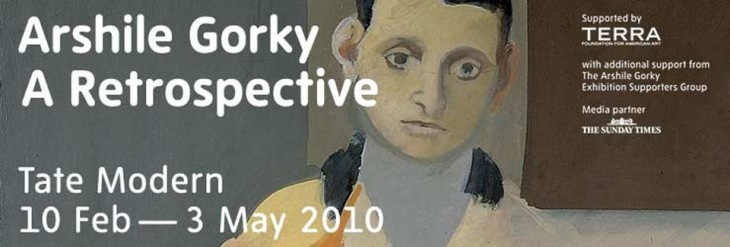
In Tate’s ‘Arshile Gorky: A Retrospective’ it is fascinating to see how, for most of the 20th century, American modern art was far far behind the European modernist brush of Cezanne, Picasso, Leger and Matisse until Gorky transcribed their techniques.  Painting in the manner of, rather than directly copying from, existing paintings, Gorky was manifest in bridging the gap between the 1920s Paris School of Art and 1940s New York American Abstract Expressionism (Pollock, de Kooning, Rothko).

Listening to his widow, Agnes ‘Mougouch’ Magruder, at Tate’s press view, still a great engineer of his legacy, enthusiastically claiming this exhibition is “wonderfully hung!”, I have to agree.  Spanning his short-lived 25 year career, the show exposes how, single-handedly, whilst developing his own art language of animated abstracts motivated by memories of his childhood in Western Armenia, Gorky is of great artistic breadth and lyricism.

After fleeing the massacres and arriving in America,  Gorky much employed his favoured yellow ochre, for looking at the spaces in between things as much as the objects themselves.  An exquisite draughtsman, drawing from 19th century the Classicalist Ingres, Gorky’s precision of line mixed with a range of paint handling techniques make him simply superb.

By engaging the eye and the mind with his imagery, his pulsating canvas becomes something compelling.  Mechanical and biomorphic forms are integrated into abstract compositions that establish a rhythmic division of space, thick under layers of paint showing how he reworked the canvas over many years.  With influences of Ucello, Poussin, David, Bosch, Michelangelo and Piero di Cosimo in ‘The Artist and his Mother’ to ‘Waterfall’.  In 1946 a fire in Gorky’s studio destroyed his work.  Then diagnosed with cancer, he required emergency surgery.  His marriage suffered.  And he committed suicide in 1948.   

©Estelle Lovatt FRSA

Van Doesburg & The International Avant Garde: Constructing A New World | Tate Modern

Theo van Doesburg Composition II (Still life) Museum Thyssen-Bornemisza, Madrid

Theo van Doesburg
Composition II (Still life)
Museum Thyssen-Bornemisza, Madrid

In 1924, after van Doesburg and Mondrian argued over a diagonal line, Mondrian (believing the horizontal and the vertical line, straight up, down and flat, to be far more vital than van Doesburg’s visually idealistic diagonal line) broke with De Stijl.  Then by means of retaliation, he created his ‘double-line’ painting ‘Composition with Double Line and Yellow, 1932’.

Academically thought-provoking, Tate’s superbly installed Van Doesburg & The International Avant Garde: Constructing A New World confirms what a lot of people don’t know; van Doesburg is to Mondrian what Picasso is to Braque.

Impressively rich in art historical detail with 350 works and documents, the exhibition’s organisation is roughly chronological.  From van Doesburg’s very early, subtle, organic embryonic ‘Girl with Buttercups’, 1914, with no hard edges, to the rigorously strict geometric stained-glass design of the beautiful ‘Composition IV’, 1917, (offering two different interpretations from either seated woman to Bach’s music), to the influence of Kandinsky’s expressionism, philosophy and Cubism.  Obsessing about a mathematical approach to composition in Mondrian’s late ‘fourth dimension’ van Doesburg wanted to make an all-encompassing universal art, applying the fourth dimension to architecture too.

By way of explanation, in a house plan, van Doesburg combined his three-dimensional coloured planes with the idea of a hypercube.  The original concrete notion of it, as, van Doesburg rationalizes, as, “The new architecture is anticube; its different spaces not contained within a closed cube. The different spaces develop unconventionally, from the centre to the periphery of the cube, so that the dimensions of height, width, depth, and time receive a new plastic expression, giving the impression of floating, suspended in air, in opposition to the natural force of gravity… The new architecture takes account not only of space but also of time as an architectural value. The unity of space and time gives architectural vision a more complete aspect.”  Allowing this collaboration and partnership of art and architecture caused great conflicts and tensions as it consented to the break-up of facades of the buildings in plans schematic about movement and passage.  By representing the fourth dimension – as a conceptual reality of an abstract non-objective expression – van Doesburg gets rid of that which already exists as being considered as conservatively behind the times, for a more modern, rhythmic and dynamically spatial effect of the future.

Theo van Doesburg Composition I (Still Life) 1916 Kröller-Müller Museum, Otterlo

Theo van Doesburg
Composition I (Still Life) 1916
Kröller-Müller Museum, Otterlo

And that’s what interested van Doesburg.  The future.  From typography to furniture.  Relentlessly continuing using the fourth dimension, long after Mondrian abandoned it, as a way of naturally continuing his work; the combination of coloured planes in three dimensional compositions.  The abstract notion of the fourth-dimension of negative space – as represented by shades of grey in relation to positive space shown in primary colours – that eliminated perspective, whilst maintaining the appearance of a three dimensional space and indirectly representing the fourth dimension, in a sense, colour was the fourth dimension, influencing Constructivism and Dadaism, designers, poets, musicians and architects such as Rietveld and Oud.

Mondrian’s appreciation for mathematics led him to his unique style of representing the fourth dimension, “by both their dimensions (line) and values (colour), arithmetic compositions can express space without the use of visual perspective.”  His experiments with the fourth dimension were interpreted through Einstein’s theory of relativity.  The complexity of van Doesburg’s art embraced Einstein’s relativity theory too, in that the fourth dimension sought to make an art form that was more ideal and more perfected than previous works.  However, Einstein rejects the opinion that the  artistic language has anything in common with his discipline, stating, “In science the principle of order which creates units is achieved through logical connection while, in art it is anchored in the unconscious.”

Then by eliminating gravity, no longer was one direction defined as ‘down’ and opposed by ‘up’, nor did the words ‘left’ or ‘right’ have meaning. All directions were equal, and only their relative orientation to each other mattered.  The machine-made look of stencil and stamp employed so you couldn’t see the ‘hand’ of the artist.  Quitting complicated forms to just use squares.  Big to small, to give a rhythm of beauty, equilibrium and stativity, about ideas of time, as in ‘Arithmetic Composition’, 1929/30.  Quite exceptional.

In 1931 van Doesburg founded another group, Abstraction-Création, which attracted the troubled American painter Arshile Gorky, who later went on to shake up the New York art scene.  After World War II, American art articulated the post-war American spirit for their go-get-ahead overconfidence, that is typically the American brag and the envy of the art world, as non-figurative modern art – Abstract Expressionism – was born.

Chris Ofili | Tate Britain

Chris Ofili, Blossom, 1997 © Chris Ofili   Photo: courtesy Contemporary Fine Arts, Berlin

Chris Ofili, Blossom, 1997 © Chris Ofili Photo: courtesy Contemporary Fine Arts, Berlin

Tate let-down is Chris Ofili.  I’m sorry, this exhibition stinks.  As an art critic it’s my job to honestly tell you this.  Masquerading under the black African experience Ofili is still, hopelessly, lacking in skill as he tries, painfully, to express the wonderful primitive fetishism of African art.  His doctrinaire formula of decorating his canvas with elephant dung and glow-in-the-dark dots of bright fluorescent colour are now nothing more than simply naïve.  Much overworked and predictably garish.

It all started going wrong when Ofili was a student. Over-rated, over-praised, he received eulogize for the superficial four-letter expletive art he created, and it destroyed him.

Look around the walls.  A firework explosion of decorative doily patterns of paint overlaid with a collage of porno photos, glitter and a beadwork of counterfeit Zimbabwean paint blobs covering elephant dung, doing the same thing, over and over, there is no development.

Enter Michael Landy’s Art Bin.

Ofili, a Turner prize winner and trustee of the Tate, saw their purchase of ‘The Upper Room’ (for £705,000), which, no doubt references the Christian’s The Last Supper.  Either, so overpoweringly unimportant as a work of art, or by design a heretical slight, his monkeys hold chalices, prove to be the best piece of this juvenile run.  What a sham(e).

©Estelle Lovatt FRSA

Isis by Simon Gudgeon

Isis

A major statue, ‘Isis’ (pictured above), has been donated to London’s Hyde Park – the first major installation to a London ‘Royal Park’ in 100 years.

The Halcyon Gallery has arranged this commission and a commemorative book, and asked me to write a profile on the sculptor, Simon Gudgeon (page 26).  These books – with a forward written by Prince Charles (page 6) — are not for sale but will be given to people who sponsor a plaque at the bottom of the statue for £1,000.

Read the press release.

©Estelle Lovatt FRSA

‘Unveiled’ – New Art from the Middle East | Saatchi Gallery

 kader_attia_ghosts_3

After 500 years of Islamic artistic tradition (calligraphy and rugs) and antediluvian codes of Shariah law, today’s artist is open to abstraction, colour, form, narrative relationships and humour.

Charles Saatchi bought art from Iraq, Iran, Syria, Lebanon and Palestine, for his latest exhibition, ‘Unveiled: New Art from the Middle East’. What surprises, more than the superb artworks themselves, is how these previously unseen artists delight in bullying their ally, America. As America’s epic celebrity is victorious with free-expression in art and artist’s individualism; as an alternative to Saddam’s handcuffs, never mind Ahmadinejad having no time for art, and Islam censoring art.

Many artists are in the States, safe from Middle Eastern challenging political and religious oppression. Understand, and appreciate, these gifted artists have only been allowed to show their work now, for the first time. Plus, that this exhibition is dominated by females makes it even more phenomenal. The victimised Middle Easterner, once subservient and suffering under Islamic culture, is now free to enjoy American liberalism. Having chosen to live in ‘Land of the Free’, why do they attack their saviour the United States?

Iranian-American, Sata Rahbar’s ‘Flag # 19 Memories Without Recollection’, has the US flag constructed from Persian textiles. Hanging upside-down, an insult to the Stars and Stripes and Americans themselves; and only to be used in times of dire emergency to signal distress. This ragged flag, approaching a traditional Amish-like Native American quilt, is worn-out with suicidal bullet belts.

In Shadi Ghadirian’s photographs, ‘Like Everyday Series’, women under burkhas have their faces replaced by everyday kitchen utensils. Reinventing themselves from the stereotype to the empowered, their one-dimensional monotone black chador replaced with Westernised floral-inspired prints.

Shirin Fakhim’s primitively coarse life-size ‘Tehran Prostitute’ sculptures reveal public attitudes about sex. Kitsch sex-dolls – sewn from stockings and melon-padded bras – these ladies-of-the-night are stuffed into over-stretched lace underwear exposing bulging phallic shapes.

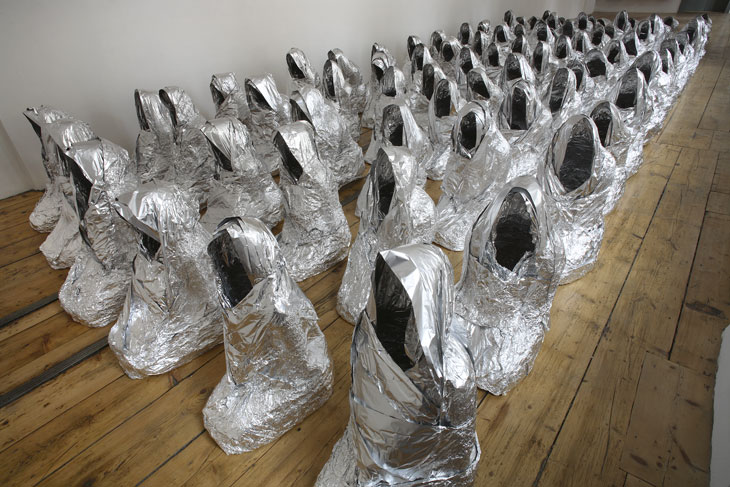
Kader Attia’s, ‘Ghost’, 240 aluminium foil sculptures of praying Muslim women – made from vacant cocoons of silver foil – are not real as people. Devoid of the ‘self’, their bodies’ are shells, hollow of person or chi. Created from a throw-away domestic material, the shiny-rich seductive food-wrap questions religion, and fast-food consumerism à la Mickey D’s.

Some artists consider 9/11 a sculptural Happening; two Minimalistic totems razed to rubble. Diana Al-Hadid, a Syrian-American, slips back time in memorial in her inverted tower. A deposed upside-down form to the World Trade Centre terrorist attacks. Tala Madani’s cartoon ‘Tower Reflection’, painted in fashionable Gitmo-orange, is of the interior of a 9/11 aeroplane targeting the Twin Towers.

Wafa Hourani’s ‘Qalandia 2067’, is a walk-through mixed media installation, with a cacophony of Arab music. Witness the cultural, political and economic instability of war-ravaged relationships. Under the gaze of Yasser Arafat, this apocalyptic scenario for the West Bank checkpoint crossing, 100 years after the 1967 six day war, is a futuristic Palestinian ‘kibbutz’. As far as I can see, protected by Israel’s security fence, as Israeli flags and American brand logotypes (Coca-Cola), symbolise their presence, against Hamas terrorism.

Not allowed to work until she moved to America, Nadia Ayari’s ‘Right of Return’ illustrates Palestinian prisoners released from an Israeli jail, witnessed by a girl growing up to be a suicide bomber, and a white cat powered by the Devil, to end Israel’s status.

These artists should look to America’s Andrew Wyeth, Grant Wood or Grandma Moses as sources of inspiration. The artist living and painting the American Dream. Instead, Ahmed Alsoudani’s rooster stands in for America’s national emblem the Bald Eagle, insulting America’s superpower status. It seems these artists find diversity desirable, and welcome independence, liberty, freedom, democracy and liberalism, so long as it’s not American.

Without barring the anti-Americana, ‘Unveiled’ is not quite Goya’s Disasters of War or Picasso’s Guernica. But, interesting and valuable in satirising and bereaving the Islamic Middle East, it is to be congratulated, as diversity is desirable, and welcomed by Americans, the Superpower of the West.

©Estelle Lovatt FRSA

Unveiled: New Art from the Middle East
Saatchi Gallery, London SW3. Until 6th May 2009.
http://www.saatchi-gallery.co.uk