McAlpine Miller: The New Collection

smc-taking-out-the-trash

It is so exciting to see McAlpine Miller’s latest artwork.

At first sight I wondered what it was, exactly, that McAlpine Miller’s newest artworks remind me of. Then it hit me. It’s the high-tech look. In them I see something of both the very modern and the nostalgic, in sync.

It is the merger of today’s science of technology with the prowess of ‘live’ cartoon action that is at the heart of his new body of artwork. And it is the clarity of these forms of his, both human and animated, that invite me ‘in’ to his frame, to be a participant. As if a play on the stage, his actors are framed in the scene through architectural elements that challenge today’s 3D space but, realising the art history of centuries past, it is as if you’re looking at a Roman Fresco that’s up to date with 3D Projection Mapping, but also stereographic 4D.

The similarities between his traditionally-painted canvases and today’s Social Media micro-electronics are what integrate his pictures. It’s as if waves of electrical quantum photons (light) take the place of both the traditional Old Master’s Classical or the Modernist’s Impressionistic prism, on level pegging. By taking the cartoons of yesterday and brightening them up with the cartoon colours of today, his sense of hue is as sophisticated as a Renaissance painter’s in softening natural looking skin tints that appear to be blended with today’s CGI pixelated palette. From traditional looking Antique White to Saddle Brown he pulls his visionary-art right bang-up-to-date through colours that are so …. of the ‘now’; of today.

Walk up any High Street, look in the fashion-chain store’s windows and you’ll see all the models dressed in the same lively, exotic, lush Pantone colours that McAlpine Miller squeezes from emerald green to chilli powder pepper red, canary yellow, tangerine tango, hot pink and peach puff. He uses colours that look as though they’re on a video display but they’re not, they’re on his canvas. Here is an artist who really understands what tomorrow’s Social Media is all about. His treatment of pictorial space is brilliant through the combination of multiple spaces and pictorial surfaces ‘released’ (painted) on ‘multiple platforms’ (picture planes) with an apparent Pixar style of animation about them. In eye-catching overlapping of graphics therein lays the McAlpine Miller Modernity.

All the things that David Hockney can do with an iPad in terms of colour, collaged composition and cut-and-paste layering, McAlpine Miller takes full circle by doing New School in an Old School style all, incredibly, with his oil paints! McAlpine Miller is taking Hockney a step further, by taking it a step backwards. Being far more complex, with traditional oil paints. His paintings have a 3D look about them. Seemingly composed through the employment of graphical cropped images edited under a CGI mouse-move, but it is all done with his sable paintbrush not the magic wand of Photoshop. With this, he paints pictures that connect with you, today. McAlpine Miller is one of the best artists of our time, painting about our time, in the best way I’ve seen. This is how he is changing the course of Art History – much in the same way that Da Vinci, Monet and Picasso did. The art of tomorrow starts here ….

Constantly looking around him at our everyday, McAlpine Miller has a set of references that are totally different to other painters. It’s as if, he says, that, “these realities combine to challenge us and perhaps create a greatly unstable world. By uncovering our real issues we discover ourselves. Undressed to the world, yet layered to the world. The illusion continues…”

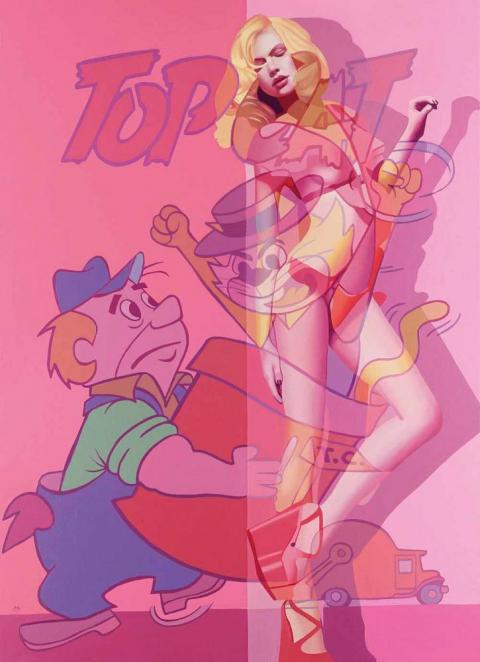
It appears like he has tagged all this in Pixar animation, transforming, for example, the imagery of Stan Lee, founder of Marvel Comics, and Hanna-Barbera of the 50s and 60s, with Steve Jobs and George Lucas’s Pixar Animation Studios of today. As in, ’Taking the Trash Out’, where Hanna Barbera is alive in Hoagy’s Alley wearing this new summer season’s high wedge sandal. It is not just about taking the trash (rubbish) out, it is about the unwanted material – the waste – as the leftovers of our forgotten civilization, about to be recycled for posterity into today’s computer jargon of the ‘trash’ of the PC world. As he points out, by, “Taking the idea of the central figure and revealing an alternative opinion of that character, [this show hopes] to reveal the ongoing nature of the transparent life. Beauty is only ever skin-deep and our ability to hide behind the facade has become something of a 21st century art form.”

Something else, for (some of) the boys, highly topical and relevant to today, you cannot close your eyes to the psychological interpretation of reference to unconscious homosexual fantasy when Batman can now legally marry Robin. With Catwoman taking the part of the witness, ready to whip you in to shape, in, ‘Woman of the Night’. DC Comics’ Batman – aka Bruce Wayne the billionaire playboy, industrialist and philanthropist that all Americans aspire to become. Whilst for the girls, in, ‘Here to Save the Day’, Superman – the fictional Superhero inspires the a-typical personification of the American, apple-pie-loving girl-next-door Gibson Girl, to show what she is prepared to do for her country, not the other way around. McApline Miller explains, “Highly celebrated and widely identified, beauty hides the ugliness of our reality. War, hatred, anger and religion make up our every day.”

Where, even as goodness Captain America slaps the enemy in the face, you’ll see that it is an extremely sexy, McAlpine Miller high-heeled heroine, in, ‘Salute to the Captain’, from a time when comics cost a slim dime, and models today are just as thin. And in, ‘A Typical Feminine Trait’, he fuses the Terrytoons animation studio with the multiplex Uncle Sam (metaphor for the United States recruiting of soldiers for the Wars), fighting wars, fighting the great ideals of justice, and even, fighting the fusion of today’s fashionable franchise branding where the references to catwalk anorexia and financial waste (and gain), connect.

McAlpine Miller achieves all this through his all-action comic book colour palette painted with his idiosyncratic, painterly, Old Master skill. Together with the industrial precision of a commercial graphic illustrator, over, the prominence of what I’d say is surely his own, Social Media edit look. All blended with Chiaroscurism’s use of shade and light. Unique to McAlpine Miller, there are two kinds of light in his paintings. The light of day, where he makes everything known and available. And the internal, spiritual, light which is when he paints all that which we can only just about imagine in our dreams. I’d be happy to live in a McAlpine Miller picture.

To help you, he splits his multi-focus Cubist compositions in to single-viewpoints of flat, fixed, fragmented planes that sculpt his storyboard characters over overlapping perspectives. Exposing them as collaged Pop Art mass culture, that looks physically disturbed by an Expressionistic revelation of images, through to an Abstract subsistence of layer-upon-layer of veiled-on oil paint revealing, informing and identifying a connection that is pure lifestyle. This is all perfectly clear as McAlpine Miller’s wholesome flesh-and-blood bikini-babes retreat to an ever-eternal return that connects the past to the present, and even the future.

There is also something of the conservative, I’d say spiritual, in his compositions too. From the triptych, ‘Three Times a Lady’, surfaces the early Christian art formatting popular for church altar paintings from the Middle Ages. McAlpine Miller’s canvas is rich in a visual legacy enabling him to project his content-aware prominence, found only in today’s world of celebrity-worship icon advertising. Amidst all of this he uses highly distinctive, iconic, 1950s Americana which he blends with Romanticism. From the portrayal of the beautiful Movie Star from the Golden-olden-good-old-days-gone-by, off-of-the-Silver-Screen, to today’s multicoloured computer-animated, backlit fluorescent light of the iPad, it’s all pure cinema.

He is both painter and public entertainer that, if Jessica Rabbit were alive today, I’m sure that McAlpine Miller would be the artist whom she’d want to be framed by.

©Estelle Lovatt FRSA

Discerning Eye Exhibition | The Mall Galleries

Being a Discerning Eye 2013 selector was a privilege.  An honour.  Nerve-wracking too!

My individually invited artists are those whose work I liked – much before I even began to understand just how extremely good their art really was.  Then I chose my open submission artists.


Deborah Azzopardi
Isabel H Langtry
Ash Naghouni
Jonty Hurwitz
McAlpine Miller
Jane McAdam Freud
Kelvin Okafor
Paul Regan
Paul Coldwell
Charlotte Hodes

I treated curating my art exhibition like a garden.  Except my garden is more like a park – a theme-park, with a variety of art so diverse, that excellent artists of all ages, and technical abilities, working in all mediums, and styles, come together.  All my artists are making artworks that I like looking at.  They cheer me up.  And they exhilarate me.

My plot reaps of a visual harvest with different tastes and styles ensuring surprises.  I love what they do.

There is the mutual ‘getting-to-know-each other’ period that occurs when you first spot the artwork you’ll fall in love with.  It’s a bit like a first date; the bioengineering of it all is ever-so-personal.  Though do remember, that even though glazed in love, a picture of a beautiful girl that is badly painted is not as pictorially stunning as a picture of an ugly girl that is beautifully painted.  All in all, I’ve artworks so alive, I’m sure they breathe.

Like your favourite soft armchair, or carbohydrates for the eyes, this is how best to experience art.  Enjoy…

Photography by Cristina Schek.

Global flight-path maps: Five interpretations

_67842750_michaelmarkieta_globalfligh

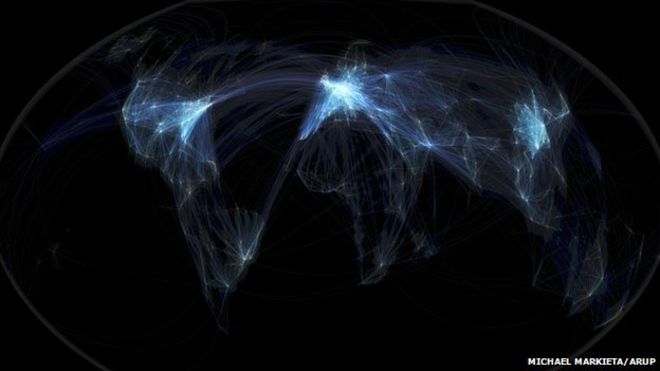
Michael Markieta’s images depicting flight paths across the planet attracted huge interest from our readers. What do the maps reveal? We asked five experts to give their interpretation.

The art critic

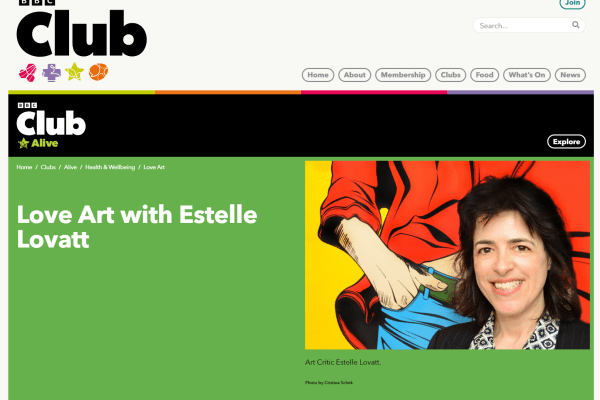
Estelle Lovatt, estellelovatt.com

Wow, it’s beautiful. It is not only dealing with two-dimensionality, it’s trying to create three dimensions, or four dimensions – giving you a notion that you are travelling across the surface of this image.

It’s almost like contemporary fractalisation – based on fractals, those beautiful divisions of science and nature. A number of artists have exploited them. Max Ernst based a lot of his surreal landscapes on fractalisation.

I would definitely exhibit these images. They give a great sense of movement and space. I think if Mark Rothko were alive today, he would be extremely inspired by this. Rothko’s half-grey and half-black paintings are sometimes thought of as purely abstract, but he was painting them at the time of the Moon landings.

One of the things artists have to do today is to keep up with contemporary visual imagery. They have to embrace modern technology, and an artwork does not just have to be oil on linen in a gilt, beautiful fixed frame. It has to be “of the time” – these are of the time and beautiful abstract shapes, very sensitively done.

The environmentalist

Bill Hemmings, aviation and shipping programme manager at Transportenvironment.org

When you see the three brightest patches – Europe, North America, and East Asia – you are seeing the three main focuses of aviation emissions. I am surprised that the Transatlantic flights do not show up as brighter because emissions are intense there as well.

The images re-affirm what we already know. Between 1974 and 2009, cumulatively, Europe was responsible for 38% of aviation traffic, Asia/Pacific was responsible for 29%, and North America for 20%.

In climate change talks, there is a lot of discussion about historical responsibility – the countries where the industrial revolution took place centuries ago bear the greatest responsibility. But in aviation it’s different. Long-haul flights, the source of most emissions, began in the 1970s, and we see that Asia is not that far behind. Not just China, but Thailand, Malaysia, Japan, Korea, and Australasia all carry a heavy responsibility.

You can see the three main areas of the world producing aviation emissions. They should take the lead in reducing them.

The aviation consultant

Europe’s hubs are bunched together – and send many flights to the Canary Islands

Europe looks so bright because it has so many short-haul flights. It’s also one of the busiest global markets and there are several hubs in relatively close proximity in Europe: Paris, Frankfurt, Amsterdam and London.

You can very clearly make out American hubs like Atlanta, Dallas, Houston and Denver – there’s a saying in the US that whether you go to heaven or hell, you have to go via Atlanta.

The map doesn’t quite reflect that the actual routes change from day to day, depending on variables like wind direction, air traffic control charges and fuel costs.

But you can see where things are changing. Asia is really dense with flight paths. In China you have a rising middle class travelling for business and leisure.

What we’re going to see in a few years is more connections between Asia and Africa, and South America and Africa, along with more “south-south” trade.

The data visualisation expert

Damien McCloud, geographic information systems, Arup

Visualisations like this are great. This is very clean and very simple and it gives an instant narrative. But my concern is that there’s a tendency to over-interpret these kinds of pictures. This is a snapshot.

You can see the density of the flights, but it doesn’t show you how many people are travelling on them. You could do that by colouring them differently.

Speaking as someone who got caught up in Hurricane Sandy last year, it would be good if you could overlay the map and show which flights are vulnerable to environmental risks.

The first thing you see is that there are three global hubs – the US, Europe and South-east Asia. If you were to overlay the major cities of the world it would show you most of them.

If you were coming from another planet and you were looking at this, you might think there weren’t many people living in Africa or Latin America.

The philosopher

Mark Vernon

It looks like a strange life-form, like seeing translucent plankton in the sea, lighting up in certain parts… and you wonder what’s going on in the darker parts, what kind of life, or activity, is concealed.

We are not seeing the life of individual human beings, but the life of the species as a whole, as if the species was one organism, pulsating like a jellyfish. Maybe it represents our collective existence?

Because of the darkness, it’s like a side of ourselves that no individual can control or understand. It feels like a dream – the collective unconscious perhaps.

In the images where the lights are denser, there is something a bit entangled and manic. It’s not completely peaceful. It’s beautiful, but when you start to look, it’s mad – a mad spider’s web, slightly psychotic.

Via: BBC

‘Family Matters’ – In Conversation With Jane McAdam Freud

Jane McAdam’s solo exhibition ‘Family Matters’, hosted by Gazelli Art House.
Jane McAdam Freud, the daughter of Lucian Freud and the great-granddaughter of groundbreaking psychologist Sigmund Freud, is an internationally acclaimed sculptor and multi disciplinary artist with a career extending over twenty years. Most often recognised for her sculpture, her work features in the permanent collections of museums and galleries around the world including the Victoria & Albert Museum in London and The Brooklyn Museum, New York.

Jane McAdam Freud, Gazelli Art House

As the daughter of probably the most famous portrait painter of his generation, Jane McAdam Freud’s latest exhibition pays tribute to her beloved father, Lucian. “I am channelling my artistic heritage and focusing on familial relationships,“ admits the London-born sculptor. “It is part of a continuing theme I have been exploring about my family. It includes a very large bronze portrait of my half-sister Annabel and sculptures of my husband and children as well as work relating to my father.“

And with a strong artistic background – her mother Katherine McAdam was also an artist – and a mixture of religious influences being half Jewish and half Catholic, Jane is continually inspired by her experiences.

“Everything in this exhibition is about the internal struggle with who I am and what my family represents to me. Family memories of my childhood are defined with positive experiences to do with art. My mother kept all my sketches and books, which I still have, and my father, Lucien, gave me most attention as a child when I was drawing. I remember him watching me when I was sketching.

“I was also very close to both my paternal grandparents, Lucie and Ernst Freud,“ she adds. “They came to visit, wrote regularly and sent wonderful birthday gifts. For those formative early years they had an influence on my life and my aspirations. In fact, I’m sure that my paternal grandmother, Lucie, was much more of an influence on me than I realise. I think that I connected to my father indirectly, through Lucie, as much as directly with him.“

But her connection with art started early. “My first experience of being enchanted with the materials and tactility of sculpture was in the sandpit at nursery school,“ she recalls. “When I first put my hands through the water into the sand I felt transformed. I cannot put into words the way it made me feel, but I knew then that I wanted to do more.”

“Then when I was at primary school, I overheard the headmistress telling a visitor during an open-day about my ability in art. She showed her some drawings that I had done in an exercise book. Overhearing the awe with which this teacher spoke was incredibly bewitching and exciting. This, I think, sealed it for me about being an artist. And it instilled in me a certain confidence about my future as an artist.“

And although Jane’s mother and paternal grandparents influenced her most growing up, it was unequivocally the act of drawing her father as he lay on his deathbed that has inspired her forthcoming exhibition more than anything else.  “That’s the last time that I saw my father,“ she admits.

“It was an extremely challenging experience but also most stimulating and very motivating. It means, meant, has been, and is, everything to me. I am highly influenced by my family and my family history, but also have something to say myself and I’m compelled to express it in an attempt to make sense of my life. Making art has given me breath – it is and has been a means of conveying my perceptions.“


“The other highlight of my exhibition is the large-scale relief of my late father, ‘EarthStone Triptych’, which is inspired by the sketches I made of him on his deathbed. It’s a memorial to his life and legacy.“

Her close-up pencil drawings look like sensitively observed donor drawings prepared for 15th century tombs, keeping his spirit alive. “Ashes to ashes, dust to dust…“ from Genesis, makes this sculpted portrait a wonderful ‘memento mori’. The process of mortality is not forgotten in the fact that clay – more than any other medium – is all about the manifestation of the four natural elements of antiquity – earth, water, air and fired combined to survive and stand along.

‘Earthstone Triptych’ is a complete installation – placed by a mirror enabling one to see both sides of the sculpture simultaneously; one side depicting “Lucien awake.  His eyes wide open. The other, not“. Getting down low to view it, I’m reminded of Holbein’s anamorphic masterpiece, The Ambassadors, with the skull of mortality only visible when vying the artwork from certain angles.  There’s also a plaque with her initials, ‘JMcAF’, on it: “this part of the sculpture“, she confides, “broke off being moved to the kiln for firing“, but it works as an effective persuasive symbol for many things, including separation.

Jane recalls her father leaving when she “was a child of eight years old, not seeing him again until I was 31, arriving back in London after studying sculpture at the Rome Academy of Fine Art.“

The rocky application of clay not only resembles him, but it is ‘of’ him, ahead of the Freudian psychological perspective that exists beyond philosophy; beyond science; beyond truth; beyond life after death (think of how flowers grow, even when beneath blankets of freezing snow).

Knowing how Freud ‘sculpted’ with paint, did he ask his daughter to teach him to sculpt? “My father did. Yes“, she says; she taught sculptural techniques during her time at the Royal Mint in South Wales. “And it shows in his painting techniques that he loved sculpture. That he was a fan of sculpture even though he was a painter! I’m sure he would have loved to have been a sculptor.“

©Estelle Lovatt FRSA

Arshile Gorky: A Retrospective | Tate Modern

arshile_gorky_restrospective_0

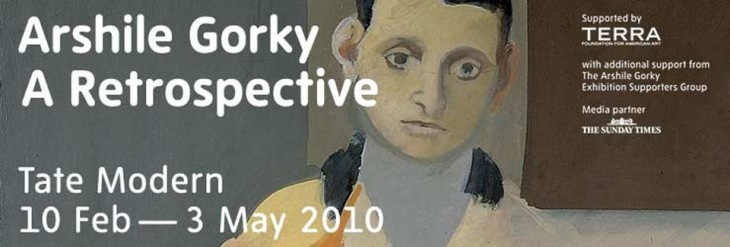
In Tate’s ‘Arshile Gorky: A Retrospective’ it is fascinating to see how, for most of the 20th century, American modern art was far far behind the European modernist brush of Cezanne, Picasso, Leger and Matisse until Gorky transcribed their techniques.  Painting in the manner of, rather than directly copying from, existing paintings, Gorky was manifest in bridging the gap between the 1920s Paris School of Art and 1940s New York American Abstract Expressionism (Pollock, de Kooning, Rothko).

Listening to his widow, Agnes ‘Mougouch’ Magruder, at Tate’s press view, still a great engineer of his legacy, enthusiastically claiming this exhibition is “wonderfully hung!”, I have to agree.  Spanning his short-lived 25 year career, the show exposes how, single-handedly, whilst developing his own art language of animated abstracts motivated by memories of his childhood in Western Armenia, Gorky is of great artistic breadth and lyricism.

After fleeing the massacres and arriving in America,  Gorky much employed his favoured yellow ochre, for looking at the spaces in between things as much as the objects themselves.  An exquisite draughtsman, drawing from 19th century the Classicalist Ingres, Gorky’s precision of line mixed with a range of paint handling techniques make him simply superb.

By engaging the eye and the mind with his imagery, his pulsating canvas becomes something compelling.  Mechanical and biomorphic forms are integrated into abstract compositions that establish a rhythmic division of space, thick under layers of paint showing how he reworked the canvas over many years.  With influences of Ucello, Poussin, David, Bosch, Michelangelo and Piero di Cosimo in ‘The Artist and his Mother’ to ‘Waterfall’.  In 1946 a fire in Gorky’s studio destroyed his work.  Then diagnosed with cancer, he required emergency surgery.  His marriage suffered.  And he committed suicide in 1948.   

©Estelle Lovatt FRSA