
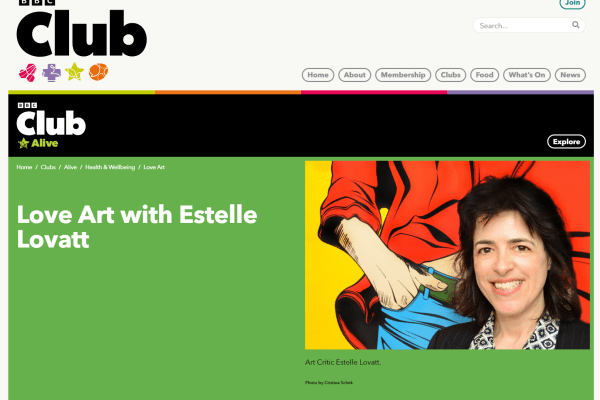
Event hosted by The Cynthia Corbett Gallery at the Gallery on Cork Street, Mayfair W1, London.
Deborah Azzopardi Book Essay

Sometimes you just want to curl up under a blanket. With a good book. A piece of chocolate. A man.
This is what Deborah Azzopardi’s pictures make me feel like doing. They are me. They remind me of the time I had a red convertible sports car. I had two, actually. And yes, they are you, too.
You immediately, automatically, engage with the narrative of Azzopardi’s conversational visual humour. Laughter is the best aphrodisiac, as you know. Never before has the erotic dream been painted by a woman so well. Think of all the furtively duplicitous sexual innuendos (worth seeing) in art history, made for the titillation of the male patron; one of the purposes of art being to arouse emotions, yes. Whilst I see some Japanese Shunga prints coarse next to Azzopardi’s more idealistic visions of contemporary urban life, the fantastical makes Azzopardi playfully sexy. And fun! Her pictures make you feel the same way, as she makes you feel the atmosphere of what goes on behind closed doors.
Azzopardi gives your fantasies a place to live, and grow, aside from the likes of Millais’s Pre-Raphaelite, ‘Isabella’, where Freudian-slips slip up against Victorian prudish angst and erections in the shadows. Azzopardi is more titillating than salacious, more sensual than sexual.
Distinctive, memorable and provocative, Azzopardi’s Pop Art shows what happens to the protagonist as her canvas acts like a storyboard for movies. Azzopardi’s definitely got the ‘When Harry Met Sally….’ – “I’ll have what she’s having” at the Katz’s Delicatessen scene, down to a fine art, in paint.
How does Azzopardi choose her topics? “I don’t choose them,” she says. “Really they choose me. I am inspired by everything I see and hear.” There’s plenty of art historical references from Dali’s frivolous daydreaming joy to Michelangelo’s abandonment of sexual fantasy; with Brancussi’s physical, bodily, dynamics through to Manet’s suggestive ‘Olympia’; Boucher’s thought-provoking, and groin-stimulating, ‘Louise O’Murphy’; Fragonard’s frivolous, knickerless, ‘The Swing’; and Courbet’s glowing ‘The Origin of the World’. But, coming from the male artist, you’d notice art history tends to sexualise art for the male patron because it’s been created by a man. Azzopardi does it her way, not in a vulgar way, through a Graphic-Figurativism that liberates women a step further than Gauguin liberated the girl with Primivitism. Further, Azzopardi is seductive with a non-threatening touch – it is fantasy, in a non-threatening way, like being comfortable with your G.B.F. (Gay Best Friend) discussing your bra size.


Provocative, flirtatious and wonderfully highlighted by playful titles, Azzopardi’s narratives interlink one painting to her next as the story progresses with messages of love and the stories of many. Juxtaposing lines of comic-book text with saucy images within a snap-shot canvas, Azzopardi paints all that you dare to fantasise about.
Unique in approach, you easily recognise an Azzopardi picture. America has Lichtenstein we have Azzopardi. Working simple graphics and toned shading (for depth), the Pop Art line that Azzopardi sketches is different to Lichtenstein’s. Hers is more curvaceous. Feminine. Whereas his lines are male, brash and clunky. And her humour is distinctively British. With the slap-and-tickle, kiss-me-quick, fun of Carry On films and quintessentially English seaside-pier-art where you poke your head through the cut-out cartoon, putting yourself in the picture. “Flash, bang, wallop! What a picture! What a photograph!” (Tommy Steele as Arthur Kipps in the London musical, ‘Half a Sixpence’). We’ve all been there done that, to be a part of visual curvaceous comedy as breasts spill over necklines, buttocks plump under panties and Y-Fronts jockey as floppy sun hats, on the English seaside coast.
Although her large colour surfaces may be simple and basic, she knows how colour works, how to use colour, so she’s not afraid to be simple and basic. It’s natural. Instinctive, like good sex is. Azzopardi’s art makes me think of the poster for ‘The Graduate’ movie when Mrs Robinson (Anne Bancroft) puts on her stockings to seduce Benjamin Braddock (Dustin Hoffman). And just as intimate as Dutch Golden Age paintings, where flirtatious bedroom games are real, Azzopardi references Vermeer in, ‘The Girl with the Diamond Earring’ (made with real diamond dust).
Azzopardi’s simple equations equal simple compositions. Timeless moments of silence that concentrate your concentration. Employing quite a Classical, Medieval, perspective, combined with bold, yet subtle gradations of colour, actually makes Pop-Art-Azzopardi more of a Formal artist. As shadows enable the texture of skin, free-flowing hair, and tender, yielding, flesh, we’d all love to look like an Azzopardi’s woman semi-nude.


Azzopardi’s use of light is an important issue too. The glow, radiance, coming from her portraits highlight the importance of personality. And the importance of experiences as ideas. This has to do with utilising the old-world aesthetics the art world has always, traditionally, celebrated. From the long-established poster-art graphics, as drawn by Toulouse-Lautrec to exude his colourful, flippant, but nevertheless elegant, sensitive and intimate message. Azzopardi, witty and thought provoking, also falls under Magritte’s Surrealist umbrella of suggestive, theatrical, poetic symbolism, as concealed in her stunning 24 carat image, ‘Pure Gold’, where lipstick is seductively applied. And of course it is red lipstick, red lips symbolise being ready for ‘intimate’ contact. When Renoir said, he’d, “painted pictures with my prick”, Azzopardi surely grabbed his baton-paintbrush, becoming the Emily Pankhurst of the art world, shaping women for our time, ensuring they never go back to the kitchen sink again. Unless they’re wearing just an apron, you’d expect.
What is ‘Push Once’ all about? A little bit of James Bond? A little bit of the Apollo 11 first moon landing? A nipple? No it’s a traditional London Routemaster bus bell. Playful, these images are foreplay. Paintings to flirt by. Paintings to fall in love by, and with. Like Manet’s art is art to flirt by, watch out, love is blooming here. Each portrait is a revelation, for ‘She’ is the girl of our day that we meet in the street. She is also Venus encompassing beauty and love. ‘He’ is Casanova, or David Beckham if you’d rather. Remember when Sam Taylor-Wood made her video-portrait of Beckham asleep, everyone – young, old, female and male, queued up to take their selfie ‘sleeping’ with him.
What inspires Deborah? “Laughter. Laughter is the best source of inspiration. Things that make you smile, or even thoughtful …. Museums, books, people; family and friends most importantly. Everything in life that surrounds me. I keep open minded and try to ‘see’ rather than just look.”
‘Close’ and ‘Closer’ are not a pair but are stunning together. This Renaissance referencing diptych makes these paintings of two parts become one as Azzopardi adopts Botticelli’s graceful, linear, rhythm. There is a sense of movement in Azzopardi’s pictures, a sense of Futurist movement. See the man’s handkerchief wiping the broken hearted woman’s tears away in ‘Forever, and ever ….’. Entitled after Aretha Franklin’s hit song, with synaesthesia, you’d hear Ms Franklin singing “I Say A Little Prayer”for you, as, music is the visual metaphor for love, the harmony being between a man and woman. Likewise there are also powerful moments of silence, as characters appear to be caught frozen in time. She uses humour to make her art timeless and enduring. The popularity of her image is similar to that enjoyed by the ‘Chinese Girl’ in the 1950s and 60s, by Vladimir Tretchikoff.
Like a pared-down Patrick Caulfield, with simple black outlines, and, big, flat, single hue, colour, Azzopardi says, “I love the use of colour on a large scale. To me the impact is in the size of the painting with the dynamism of colour.” Much in the same vein as Yves Klein had his blue, Azzporadi has hers. Her colours serve as initial bait to gain your attention, but it is her subject matter that hooks you in, and keeps you captivated, as male torsos are toned and long female legs dangle over the side of a red convertible.


What makes her paint? She just likes to paint. “I have always wanted to paint! I don’t understand why everyone in the world doesn’t paint! It’s probably like an addiction. Although I’m not an addict. Only to chocolate! I think I just paint because I like the subject idea, without any great meaning or explanation.” Says Azzopardi. Even the fashion illustrator from the haute couture world of major designers, René Gruau, makes Azzopardi want to paint. It’s his elegant, economic, use of line.
Like Gruau, Azzopardi draws from real life models too. Beautifully honed, Ralph Lauren model-types, with pert breasts and firm thighs can be seen to be as iconic as Leonardo’s ‘Mona Lisa’, Warhol’s ‘Monroe’ or Goya’s ‘The Naked Maja’. Except, each of Azzopardi’s portraits has three faces. One facing the past of art history; one facing our time – the ‘here-and-now’; and one facing tomorrow – the future.
There is something ‘Wonder Woman’-esque about her colourful pictures that makes you believe the girl is the superhero who triumphs not with punches or kicks, but with love. Images, as bright and bold as I used to be. Indeed can be again, for something about them makes me feel young, like I’m standing by the Fountain of Youth. Youth symbolizes incorruptible purity.
If you think her paintings are lively, you should meet her in person! She’s got a personality that stands out like one of her paintings and a laugh that’s vivacious and colourful. When Jackson Pollock said, “Every good painter paints what he is”, he’d surely be talking about Deborah Azzopardi ….
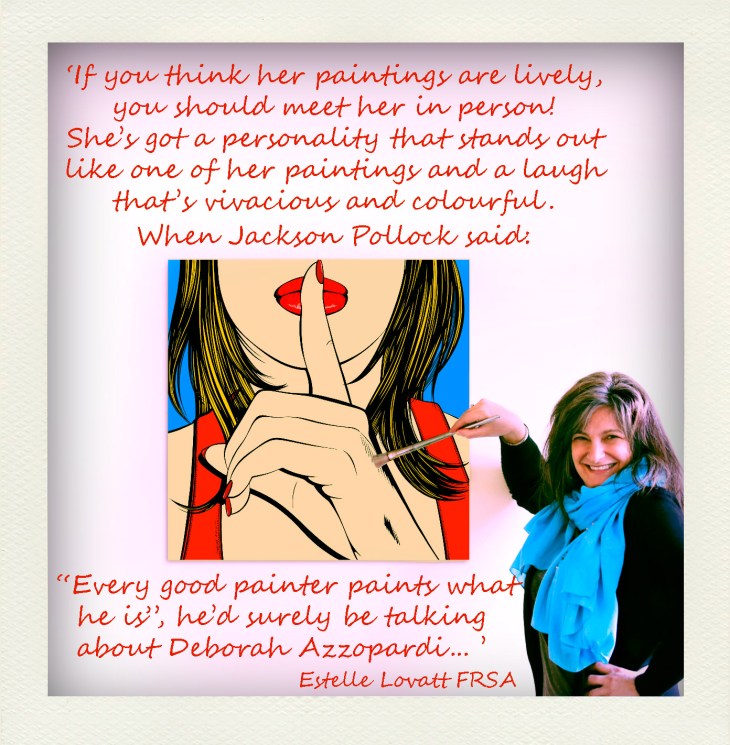
Essay published in 2014, in Deborah Azzopardi’s debut book.
Images design by Cristina Schek, using artwork by Deborah Azzopardi & quotes by Estelle Lovatt FRSA.
© Estelle Lovatt FRSA
McAlpine Miller: The New Collection
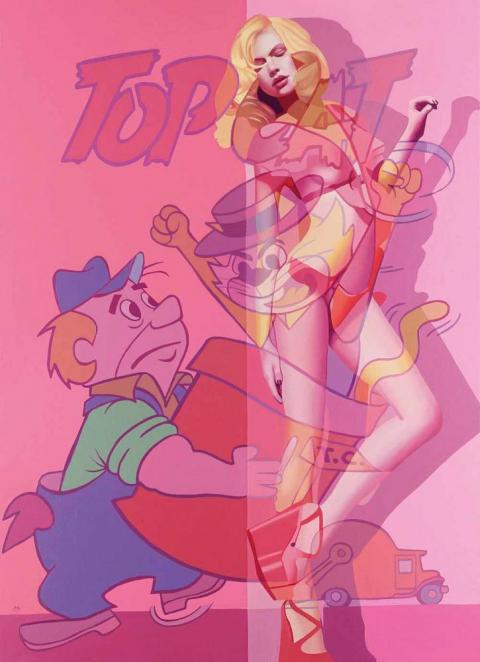
It is so exciting to see McAlpine Miller’s latest artwork.
At first sight I wondered what it was, exactly, that McAlpine Miller’s newest artworks remind me of. Then it hit me. It’s the high-tech look. In them I see something of both the very modern and the nostalgic, in sync.
It is the merger of today’s science of technology with the prowess of ‘live’ cartoon action that is at the heart of his new body of artwork. And it is the clarity of these forms of his, both human and animated, that invite me ‘in’ to his frame, to be a participant. As if a play on the stage, his actors are framed in the scene through architectural elements that challenge today’s 3D space but, realising the art history of centuries past, it is as if you’re looking at a Roman Fresco that’s up to date with 3D Projection Mapping, but also stereographic 4D.
The similarities between his traditionally-painted canvases and today’s Social Media micro-electronics are what integrate his pictures. It’s as if waves of electrical quantum photons (light) take the place of both the traditional Old Master’s Classical or the Modernist’s Impressionistic prism, on level pegging. By taking the cartoons of yesterday and brightening them up with the cartoon colours of today, his sense of hue is as sophisticated as a Renaissance painter’s in softening natural looking skin tints that appear to be blended with today’s CGI pixelated palette. From traditional looking Antique White to Saddle Brown he pulls his visionary-art right bang-up-to-date through colours that are so …. of the ‘now’; of today.
Walk up any High Street, look in the fashion-chain store’s windows and you’ll see all the models dressed in the same lively, exotic, lush Pantone colours that McAlpine Miller squeezes from emerald green to chilli powder pepper red, canary yellow, tangerine tango, hot pink and peach puff. He uses colours that look as though they’re on a video display but they’re not, they’re on his canvas. Here is an artist who really understands what tomorrow’s Social Media is all about. His treatment of pictorial space is brilliant through the combination of multiple spaces and pictorial surfaces ‘released’ (painted) on ‘multiple platforms’ (picture planes) with an apparent Pixar style of animation about them. In eye-catching overlapping of graphics therein lays the McAlpine Miller Modernity.
All the things that David Hockney can do with an iPad in terms of colour, collaged composition and cut-and-paste layering, McAlpine Miller takes full circle by doing New School in an Old School style all, incredibly, with his oil paints! McAlpine Miller is taking Hockney a step further, by taking it a step backwards. Being far more complex, with traditional oil paints. His paintings have a 3D look about them. Seemingly composed through the employment of graphical cropped images edited under a CGI mouse-move, but it is all done with his sable paintbrush not the magic wand of Photoshop. With this, he paints pictures that connect with you, today. McAlpine Miller is one of the best artists of our time, painting about our time, in the best way I’ve seen. This is how he is changing the course of Art History – much in the same way that Da Vinci, Monet and Picasso did. The art of tomorrow starts here ….
Constantly looking around him at our everyday, McAlpine Miller has a set of references that are totally different to other painters. It’s as if, he says, that, “these realities combine to challenge us and perhaps create a greatly unstable world. By uncovering our real issues we discover ourselves. Undressed to the world, yet layered to the world. The illusion continues…”
It appears like he has tagged all this in Pixar animation, transforming, for example, the imagery of Stan Lee, founder of Marvel Comics, and Hanna-Barbera of the 50s and 60s, with Steve Jobs and George Lucas’s Pixar Animation Studios of today. As in, ’Taking the Trash Out’, where Hanna Barbera is alive in Hoagy’s Alley wearing this new summer season’s high wedge sandal. It is not just about taking the trash (rubbish) out, it is about the unwanted material – the waste – as the leftovers of our forgotten civilization, about to be recycled for posterity into today’s computer jargon of the ‘trash’ of the PC world. As he points out, by, “Taking the idea of the central figure and revealing an alternative opinion of that character, [this show hopes] to reveal the ongoing nature of the transparent life. Beauty is only ever skin-deep and our ability to hide behind the facade has become something of a 21st century art form.”
Something else, for (some of) the boys, highly topical and relevant to today, you cannot close your eyes to the psychological interpretation of reference to unconscious homosexual fantasy when Batman can now legally marry Robin. With Catwoman taking the part of the witness, ready to whip you in to shape, in, ‘Woman of the Night’. DC Comics’ Batman – aka Bruce Wayne the billionaire playboy, industrialist and philanthropist that all Americans aspire to become. Whilst for the girls, in, ‘Here to Save the Day’, Superman – the fictional Superhero inspires the a-typical personification of the American, apple-pie-loving girl-next-door Gibson Girl, to show what she is prepared to do for her country, not the other way around. McApline Miller explains, “Highly celebrated and widely identified, beauty hides the ugliness of our reality. War, hatred, anger and religion make up our every day.”
Where, even as goodness Captain America slaps the enemy in the face, you’ll see that it is an extremely sexy, McAlpine Miller high-heeled heroine, in, ‘Salute to the Captain’, from a time when comics cost a slim dime, and models today are just as thin. And in, ‘A Typical Feminine Trait’, he fuses the Terrytoons animation studio with the multiplex Uncle Sam (metaphor for the United States recruiting of soldiers for the Wars), fighting wars, fighting the great ideals of justice, and even, fighting the fusion of today’s fashionable franchise branding where the references to catwalk anorexia and financial waste (and gain), connect.
McAlpine Miller achieves all this through his all-action comic book colour palette painted with his idiosyncratic, painterly, Old Master skill. Together with the industrial precision of a commercial graphic illustrator, over, the prominence of what I’d say is surely his own, Social Media edit look. All blended with Chiaroscurism’s use of shade and light. Unique to McAlpine Miller, there are two kinds of light in his paintings. The light of day, where he makes everything known and available. And the internal, spiritual, light which is when he paints all that which we can only just about imagine in our dreams. I’d be happy to live in a McAlpine Miller picture.
To help you, he splits his multi-focus Cubist compositions in to single-viewpoints of flat, fixed, fragmented planes that sculpt his storyboard characters over overlapping perspectives. Exposing them as collaged Pop Art mass culture, that looks physically disturbed by an Expressionistic revelation of images, through to an Abstract subsistence of layer-upon-layer of veiled-on oil paint revealing, informing and identifying a connection that is pure lifestyle. This is all perfectly clear as McAlpine Miller’s wholesome flesh-and-blood bikini-babes retreat to an ever-eternal return that connects the past to the present, and even the future.
There is also something of the conservative, I’d say spiritual, in his compositions too. From the triptych, ‘Three Times a Lady’, surfaces the early Christian art formatting popular for church altar paintings from the Middle Ages. McAlpine Miller’s canvas is rich in a visual legacy enabling him to project his content-aware prominence, found only in today’s world of celebrity-worship icon advertising. Amidst all of this he uses highly distinctive, iconic, 1950s Americana which he blends with Romanticism. From the portrayal of the beautiful Movie Star from the Golden-olden-good-old-days-gone-by, off-of-the-Silver-Screen, to today’s multicoloured computer-animated, backlit fluorescent light of the iPad, it’s all pure cinema.
He is both painter and public entertainer that, if Jessica Rabbit were alive today, I’m sure that McAlpine Miller would be the artist whom she’d want to be framed by.
©Estelle Lovatt FRSA
Can spending millions on art ever be a good investment?

Consider the idea of spending $142m (£89m, 106m euros) on a work of art and then being told you have bagged a bargain.
A number of art critics have said that the price paid for Three Studies of Lucian Freud (1969), by Francis Bacon, is money well spent.
While the anonymous new owner decides how to insure and where to hang the triptych, stretched householders may wonder how a purchase like this could ever be a good deal.
And should they decide to invest in art themselves – at a less spectacular level – then there are warnings that the value of such items can go down as well as up.
Crisis? What crisis?
The Bacon masterpiece became the most expensive artwork ever sold at auction when it went under the hammer after six minutes of frantic bidding.
Calculations by The Economist suggest that Van Gogh’s 1890 work Portrait du Docteur Gachet actually cost more at auction if inflation is taken into account. The $82.5m paid for that painting in 1990 is the equivalent of $148.6m at today’s prices, the magazine says.
Some people say it is vulgar to talk about art and money at the same time. Estelle Lovatt , Art critic
Meanwhile, in 2011, the Qatari royal family paid more than $250m for a Cezanne in a private sale, The Economist adds.
All the same, $142m is an eye-watering amount of money, even though there are three paintings in the set, and especially as we are only slowly emerging from a global financial crisis.

A total of £782m was spent during the Christie’s auction of post-war and contemporary art that night.
On the same day as the Bacon sale, a diamond known as the Pink Star sold for $83m (£52m, 62m euros) at auction in Geneva – the highest auction price for a gemstone.
“At the moment people wonder how come art is securing such funds,” says art critic Estelle Lovatt.
“When you consider interest rates at the banks at the moment, your money works much better and the result looks much prettier on the wall or on a plinth.
“It has been an incredible year [for art sales], especially given the financial situation.
“Some people say it is vulgar to talk about art and money at the same time – cash is the C-word in the art world. But it is a great investment.”
Or is it?
Top v bottom
Just a few hours after record-breaking sums were being bid in New York and Geneva, a watercolour work called Portrait of a Lady was sold for £238 at an auction in Edinburgh.
Another watercolour entitled Flower Arrangement went under the hammer for £275, and the top sale of the day was a mahogany bookcase that fetched £18,750.
Auctions such as this are taking place across the country most days of the week, buoyed in part by the popularity of daytime TV auction shows such as Antiques Roadshow and internet auction sites.

Yet, it is a two-pace market, according to Richard Madley, a fellow of the National Association of Valuers and Auctioneers (NAVA).
“It is akin to the London housing market compared to the rest of the UK, where prices go up and up in the capital,” he says.
“A work by Bacon is like an eight-bedroom house in Belgravia, while the chest of drawers is the two-bedroom cottage in the North East which remains affordable,” he says.
While the global super-rich keep spending record-breaking amounts at the top end of the market, prices of domestic, lower-value antiques have tumbled, he says.
For example, last year, $119.9m (£74m) was paid for Edvard Munch’s The Scream, whereas in the last 10 years the typical price of a traditional dinner service or a Victorian wardrobe has halved.
The reason is that masterpieces will usually retain their appeal, while lower level furniture and art are at the mercy of fashion.
“Antiques are not cool. Young people in their 30s and 40s do not want what their parents hung on the wall; they do not want a big Victorian extending dining table; they want glass and chrome,” Mr Madley says.
Chinese lesson
Anyone considering taking the risk of investing could look for a lesson in the market for works from China and Japan, according to auctioneer Mr Madley.
Bidding for Japanese porcelain hit its height in the 1990s but prices have fallen since.
Yet, as disposable income rises in China, the new middle class and wealthy are buying back the heritage that left the country in decades past. Chinese ceramics, bronzes, jade and metalwork are proving particularly popular.
In one case, Mr Madley says, a Chinese pottery bowl that had a reserve price of £200 sold for £37,000. A lot such as this is known as a sleeper, which is awoken by frantic bidding.
Anyone thinking of buying at auction for the first time should ask for help before the bidding starts, Mr Madley suggests, and they do not need to worry that scratching their nose could be mistaken as a bid and cost them thousands of pounds.
“Auctioneers look for serious bidding signals, and bidders now are often given a piece of paper with their number on when they register,” he says.
Auction tips:
- Visit an auction to watch before taking part
- Look at the guide prices in the catalogue
- Go to a preview to see what is being sold
- Do not forget the extra cost of the buyer’s premium – the auctioneer’s fee
- Have a look around on preview days, talk to the auctioneer, and pick up a catalogue
- Look at the guide price. The minimum amount that the seller will accept is confidential, but cannot exceed the lower estimate
- Watch an auction first, before taking part
- Remember the extra charge, known as a buyer’s premium. It can vary from 5% to 25% of the bid price. Ask about the cost beforehand
The most important advice when buying art, according to Mr Madley, was a tip he was given as a young man by one of his bosses.
“Buy art with your eyes and not your ears. It must give you pleasure to look at it, don’t buy it because someone tells you it will be worth more in a few years’ time,” he says.
Still, ask anyone who was at the auction of the Bacon triptych last week, and they will say that as the bidding hit stratospheric levels, they could believe neither their eyes nor their ears.
‘Go Figurative’ : Going Back To Figurative Art via Barack Obama
Since the 1990s, the phrase Conceptual Art has been unfairly manipulated to become an all-encompassing term, generating derision, which some erroneously apply to the Turner Prize, and other anti-figurative art.
As change comes politically, so it follows artistically with art imitating politics, reflecting its time. And so it was, that under former-President George W. Bush art moved towards temporary sculpture, with artists remembering 9/11 as a ‘sculptural’ event based around two Giacometti-tall Judd-shiny minimal ‘sculptures’, razed to the ground. Demolished as a Happening art-from. Now with President Obama in charge, figurative artist Shepard Fairey was selected to paint Barack’s official Presidential portrait. Deem it au courant for artists to investigate the ‘self’, promoting the figurative back into art, back into vogue.
Putting the ‘F’ word, figurative, into ‘Neo-Figurativism’, Go Figurative – a new web site gallery championed by co-founders and Directors Sally Perry and Janine Collins – respects the value and importance of reality-based fine art. With creative ability, aesthetic value and sound artistic judgement, Go Figuratives’s Figurescapists depict life, retaining strong references to the real world and the human figure understanding what Picasso projected, when he said, “There is no abstract art. You must always start with something figurative.”
As our visual appetite demands something that is visually easier to understand, Go Figurative believes traditional artist’s skills, which have been lost amid cries of ‘my child could do that!’ are reworked and brought up-to-date by ‘Neo-Figurativists’.
Working from reality and object sources referencing the real world, creative rationale is being brought back to contemporary art. Reinforced by representational masters from the likes of Giacometti, Bacon, Freud and Hirst, who all appreciate strong figurative references (marked since Egyptian idealization through Classical sculpture, the Realism of Courbet and Manet, through to contemporaneous modern art today) in fine art, as aesthetically satisfying.
Principally, the philosophical question is not whether a work of art is, indeed, a work of art, but, does it need to be aesthetically pleasing? Well, yes, it does. If art does not aim at having aesthetic value, what then, will set it apart from non-art? Making the ghost-of-Rubens proclaim of us again, “This Island seems worthy the consideration of a man of taste…by the incredible quantity of excellent pictures and statues.”
Ivan Massow (one-time Chairman of the Institute of Contemporary Arts) and Kim Howells (once Culture Minister who denounced the Turner Prize as “cold, mechanical, Conceptual bullshit”), think that which is artistically deficient, posing as Conceptualism, appalling. Even the banknote-rich culture-poor agree these vacuous non-aesthetic DIY efforts fall apart, on many levels. It is only saved from degeneration, with the talent and skill that is Martin Creed, Rachel Whitread, Simon Patterson, Simon Starling, Bethan Huws, Douglas Gordon and Liam Gillick. Even Tracey Emin’s ‘My Bed’ is effectively ingenious.
Don’t misunderstand; there is some wonderful, breathtaking, eye-popping Conceptualism. But it’s dated 1960/70s. When it was truly brilliant, it responded to political and social changes of the time, and of Dadaism, Surrealism, Suprematism, Abstract Expressionism and Fluxus. It was awe-inspiring, humbling even. Yet Conceptual artist Sol Lewitt said, “Ideas can be works of art; ideas need not be made physical as a work of art may be understood as a conductor from the artist’s mind to the viewer’s. But it may never reach the viewer or it may never leave the artist’s mind”. This is the problem with today’s unskilled ‘Bob-the-Builder’ artist, refilling Duchampian type urinals with copycat tins of Manzoni-faeces. It’s been done before, only better.
A difficult symptom of the mentality of the amateur Conceptual artist is his disproportionate concern with manifestos and unintelligent commentary, absolutely necessary in explaining his political aims and methods. All hype, this badly-made tat – unfortunately posing as Conceptual art – gives art a bad name. With no aesthetic value, its best described as rubbish-tip utility ware. A craze mercifully not lasting its anti-establishment anti-consumerist spirit longer than Warhol’s prescribed fifteen minutes.
Wave goodbye to the shocking ‘wannabe’, devoid of originality and ignorant of any creative craft that fine art labour alone brings with competence. The second-rate artist fraud recognised by the way he despises the delicate tools and beautiful material great artists always delight in handling. So he fails to draw on them.
As we see the beginning of the end of this quick slick Art Star, we are now buying art for sheer enjoyment and attraction to the art itself, created by the enormously talented. Those now reinventing the objective that is present in figurative art, focus on the positives of the aesthetic; beauty and skill. Cherry-picking from these Go Figurative’s perhaps lesser-known artists means you pick art that will increase in value as their career credentials and sales increase. Furthermore, as the buyer, you are rewarded from living with the artwork.
And no better time than now in a recession, to buy art, and to consider the valuable lessons we’ve learnt from the 1930s Great Depression; when money is limited, people find distraction and calm in art. As Wall Street opened the art world to new talent and ideas, artists started making worthy, affordable, intelligent, original and innovative art.
Also remember that after the UK’s last financial crash (late 1980s), the art world’s tightly guarded gates opened up to new talent, with fresh ways of thinking and seeing, which proved magnificent with the YBAs (Young British Artists).
The virtual internet gallery and community, Go Figurative, is the latest innovative on-line market place for talented sculptors, painters, photographers and print makers to form collectives with like minded professional artists, buyers, art critics and art historians.
The response from figurative artists has been significant. Whilst many have websites, most do not, and even those that do lack the traffic to be able to create significant awareness through them. Perry adds, “The artists I have spoken with have responded well to the idea of community based website focussed purely on figurative art. They like the idea of having a platform dedicated to the work which has references to reality at its core”. The concept of the future is figurative. www.gofigurative.com
© Estelle Lovatt FRSA
Discerning Eye Exhibition | The Mall Galleries

Being a Discerning Eye 2013 selector was a privilege. An honour. Nerve-wracking too!
My individually invited artists are those whose work I liked – much before I even began to understand just how extremely good their art really was. Then I chose my open submission artists.
Deborah Azzopardi
Isabel H Langtry
Ash Naghouni
Jonty Hurwitz
McAlpine Miller
Jane McAdam Freud
Kelvin Okafor
Paul Regan
Paul Coldwell
Charlotte Hodes
I treated curating my art exhibition like a garden. Except my garden is more like a park – a theme-park, with a variety of art so diverse, that excellent artists of all ages, and technical abilities, working in all mediums, and styles, come together. All my artists are making artworks that I like looking at. They cheer me up. And they exhilarate me.
My plot reaps of a visual harvest with different tastes and styles ensuring surprises. I love what they do.
There is the mutual ‘getting-to-know-each other’ period that occurs when you first spot the artwork you’ll fall in love with. It’s a bit like a first date; the bioengineering of it all is ever-so-personal. Though do remember, that even though glazed in love, a picture of a beautiful girl that is badly painted is not as pictorially stunning as a picture of an ugly girl that is beautifully painted. All in all, I’ve artworks so alive, I’m sure they breathe.
Like your favourite soft armchair, or carbohydrates for the eyes, this is how best to experience art. Enjoy…
Photography by Cristina Schek.


Antony Gormley comments: “I’m interested in Abraham because I see him carrying on the work Orozco and others in Mexico started, which is really dealing with contemporary urban life from the point of nothing, from the street, and doing that in a very intelligent way, a very open way, and celebrating the inherent hope of those that make something from nothing.”


 Estelle Lovatt