‘Unveiled’ – New Art from the Middle East | Saatchi Gallery

 kader_attia_ghosts_3

After 500 years of Islamic artistic tradition (calligraphy and rugs) and antediluvian codes of Shariah law, today’s artist is open to abstraction, colour, form, narrative relationships and humour.

Charles Saatchi bought art from Iraq, Iran, Syria, Lebanon and Palestine, for his latest exhibition, ‘Unveiled: New Art from the Middle East’. What surprises, more than the superb artworks themselves, is how these previously unseen artists delight in bullying their ally, America. As America’s epic celebrity is victorious with free-expression in art and artist’s individualism; as an alternative to Saddam’s handcuffs, never mind Ahmadinejad having no time for art, and Islam censoring art.

Many artists are in the States, safe from Middle Eastern challenging political and religious oppression. Understand, and appreciate, these gifted artists have only been allowed to show their work now, for the first time. Plus, that this exhibition is dominated by females makes it even more phenomenal. The victimised Middle Easterner, once subservient and suffering under Islamic culture, is now free to enjoy American liberalism. Having chosen to live in ‘Land of the Free’, why do they attack their saviour the United States?

Iranian-American, Sata Rahbar’s ‘Flag # 19 Memories Without Recollection’, has the US flag constructed from Persian textiles. Hanging upside-down, an insult to the Stars and Stripes and Americans themselves; and only to be used in times of dire emergency to signal distress. This ragged flag, approaching a traditional Amish-like Native American quilt, is worn-out with suicidal bullet belts.

In Shadi Ghadirian’s photographs, ‘Like Everyday Series’, women under burkhas have their faces replaced by everyday kitchen utensils. Reinventing themselves from the stereotype to the empowered, their one-dimensional monotone black chador replaced with Westernised floral-inspired prints.

Shirin Fakhim’s primitively coarse life-size ‘Tehran Prostitute’ sculptures reveal public attitudes about sex. Kitsch sex-dolls – sewn from stockings and melon-padded bras – these ladies-of-the-night are stuffed into over-stretched lace underwear exposing bulging phallic shapes.

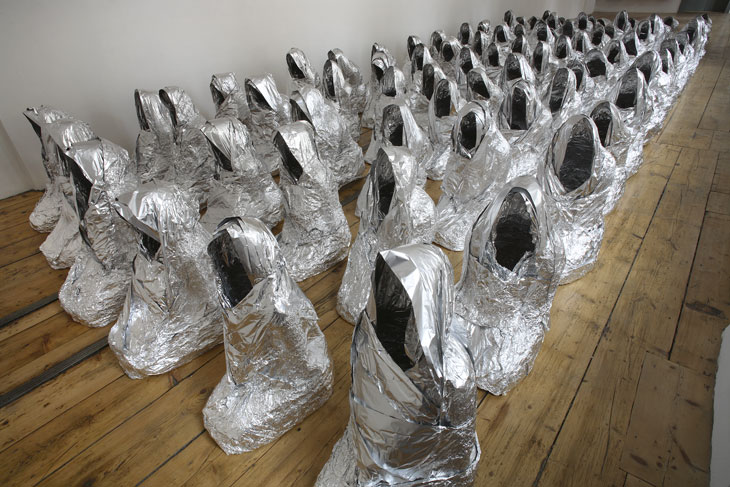
Kader Attia’s, ‘Ghost’, 240 aluminium foil sculptures of praying Muslim women – made from vacant cocoons of silver foil – are not real as people. Devoid of the ‘self’, their bodies’ are shells, hollow of person or chi. Created from a throw-away domestic material, the shiny-rich seductive food-wrap questions religion, and fast-food consumerism à la Mickey D’s.

Some artists consider 9/11 a sculptural Happening; two Minimalistic totems razed to rubble. Diana Al-Hadid, a Syrian-American, slips back time in memorial in her inverted tower. A deposed upside-down form to the World Trade Centre terrorist attacks. Tala Madani’s cartoon ‘Tower Reflection’, painted in fashionable Gitmo-orange, is of the interior of a 9/11 aeroplane targeting the Twin Towers.

Wafa Hourani’s ‘Qalandia 2067’, is a walk-through mixed media installation, with a cacophony of Arab music. Witness the cultural, political and economic instability of war-ravaged relationships. Under the gaze of Yasser Arafat, this apocalyptic scenario for the West Bank checkpoint crossing, 100 years after the 1967 six day war, is a futuristic Palestinian ‘kibbutz’. As far as I can see, protected by Israel’s security fence, as Israeli flags and American brand logotypes (Coca-Cola), symbolise their presence, against Hamas terrorism.

Not allowed to work until she moved to America, Nadia Ayari’s ‘Right of Return’ illustrates Palestinian prisoners released from an Israeli jail, witnessed by a girl growing up to be a suicide bomber, and a white cat powered by the Devil, to end Israel’s status.

These artists should look to America’s Andrew Wyeth, Grant Wood or Grandma Moses as sources of inspiration. The artist living and painting the American Dream. Instead, Ahmed Alsoudani’s rooster stands in for America’s national emblem the Bald Eagle, insulting America’s superpower status. It seems these artists find diversity desirable, and welcome independence, liberty, freedom, democracy and liberalism, so long as it’s not American.

Without barring the anti-Americana, ‘Unveiled’ is not quite Goya’s Disasters of War or Picasso’s Guernica. But, interesting and valuable in satirising and bereaving the Islamic Middle East, it is to be congratulated, as diversity is desirable, and welcomed by Americans, the Superpower of the West.

©Estelle Lovatt FRSA

Unveiled: New Art from the Middle East
Saatchi Gallery, London SW3. Until 6th May 2009.
http://www.saatchi-gallery.co.uk

Behind the Veil

201004061302489557

The art exhibition ‘Veil’, at Modern Art Oxford, Oxford, England, 2004, looks at the symbolic consequences of the veil and veiling in contemporary culture, in the work of twenty international artists. Veil matches photography, film, video and sculpture, and merges historic material with fancy contemporary work.

The veil has come to be observed as a declaration of religious and cultural differences, affiliated with foreign political assumptions of the East, and developing a symbol of cultural oppression. The art exhibition Veil tempts a more perplexing interpretation of this garment, in the spin of sexuality, limits of the body, censorship as the visible symbol of women, history, religion and politics.

The veil is barely an Islamic innovation, that has been used in art from the earliest Biblical illustrations of the Old Testament, Genesis, when Jacob fell in love with Rachel, but was tricked into marrying her sister Leah instead, to paintings of the Virgin in prayer. Here the veil is overworked with symbolism: brides put on white veils, widows parade black ones. Consequently the veil symbolises death and wedded joy. From black to white. From good to bad. From artists Robert Mapplethorpe to Matisse.

The most tasteless artworks on show at Veil include large-scale photographs by the Jewish Moscow-based art collective, AES art group, from the series ‘The Witnesses of the Future’. AES art group was established in 1987 and consists of three Russian Jewish artists: Tatiana Arzamasova, Lev Evzovich and Evgeny Svyatsky, all of whom live and work in Moscow. AES create deceptive and deceiving Machiavellian cityscapes of the leading Western capitals, from New York to Paris, Rome to Sydney, Moscow to Berlin – in the year 2006, imagining how they could rise under a changed regime.

Hence AES’s photograph of the Statue of Liberty dressed in a full white burka, carrying a Koranic text where the Declaration of Independence should be, is both ridiculous and foolish. This photograph, ‘New Freedom 2006, AES The Witness of the Future’, is anti-American because it is the gravest assault on American civil liberties.

The French gave the Statue to the people of the United States over one hundred years ago in recognition of the friendship established during the American Revolution. On October 28th, 1886 President Grover Cleveland accepted the Statue on behalf of the United States and said “We will not forget that Liberty has here made her home; nor shall her chosen altar be neglected.” Over the years, the Statue of Liberty has grown to embrace freedom and democracy.

It is not unanticipated, nor casual, that post 9/11,the veil has been relied on as a potent abbreviation that takes on dress codes as symbolic of oppression. But this wrapping of the Statue of Liberty will not convert its nature, or its significance.

Moreover it is a cheap and tacky political joke by the AES. And the fact that these artists who make up the AES collective are all Jewish is even more offensive and prosaic. The AES artists should know better, especially as Jews, with Judaism teaching respect for women, and female liberation. I am not saying a woman covered up with a veil is a religious fundamentalist. Of course not. Some do not cover up. Take a look at Wafa Idrees, who, on 31 January 2002, was the first woman Palestinian suicide bomber who killed one Israeli and injured 140 others in Jerusalem. She didn’t cover up.

Wallowing in satire, AES’s digitally manipulated images are storyboards, chasing the deep-rooted phobia of today’s post-modern, postcolonial, post-Cold War alliance. Catching within their artwork an endorsement of ceremony, they have lost their taste for discernment and truth, acquiring instead a surreptitiously shrouded and veiled anti-Americanism that paradoxically hungers for anything substantially American. This is a love-to-hate oxymoron coerced by a routine taste for everything American, from America’s soda, burgers and fries, to America’s independence, America’s freedom, and moreover for America’s liberty.

When, in the 1970s, the regime of Egyptian President Anwar Sadat signed a peace treaty with Israel, the Soviet Union turned away. So perhaps it is not too surprising that the Communist Russian art group AES have come up with this insulting and upsetting fusion of political acrimony. Casually veiled anti-Americanism it is, unfortunately, very very Russian.

With the veil regarded as an Islamic institution associated with Muslims and Islam, this mock art is anything but anti-Islamicism. It is in fact insulting and abusive to Westerners, in what is nothing more than an invidious and crude attack, principally post 9/11.

Another AES photograph, ‘London 2006’ has an onion dome capping the top of Big Ben and columns on top of the Houses of Parliament like a mosque. This is futile, not realising what can restore can also destroy, and it gives false credence and testimony to the invention that Islam is totalitarian.

Other Veil far-left artists have made similar graphic mistakes that surely add up to more war. Remember, the French President Jacques Chirac denouncing Muslim headscarves on schoolgirls as offensive, and expressed concern about “something aggressive” in the wearing of Muslim veils is simply outrageous racism. Consider too, the German Chancellor Gerhard Schr?der restricting the wearing of religious dress. This de-veiling of a woman is a sin, akin to rape, hardly a position the anti-war movement can support.

The surplus of artwork is solely anti-Western and has nothing to do with veils. And even less to do with Islamophobia. From Communism to terrorism, what it combines is the rationalisation of George Bush’s fear of violence post 9/11. It fuses the alliance between al-Qaida, the Taliban, the Afghanistans and Edward Said’s influence as the spirit of left post-structuralism and Orientalism.

Islamic art has dominated Western artistic traditions for over five hundred years. As Islamic art opened up the possibilities of abstraction, of colour fields, of relationships between form and content, it is a shame these artists did not use the challenge of Veil, and break free from the constraints of Western artistic practices, instead of using this opportunity to turn the veil into a cultural, religious and political phenomenon.

© Estelle Lovatt FRSA