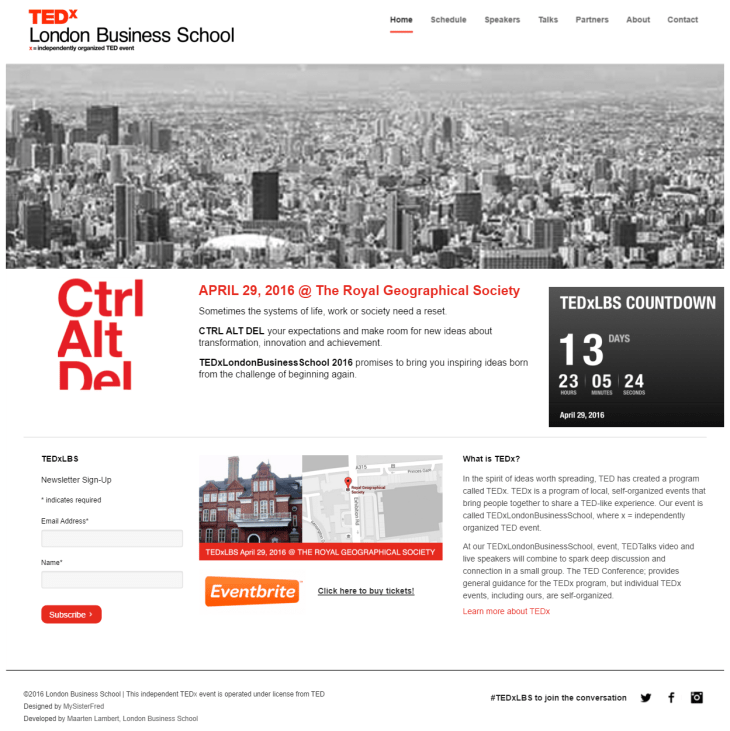
Save the date: April 29, 2016 | TEDxLondonBusinessSchool 2016 @ The Royal Geographical Society.

Delighted to announce that I’m one of the speakers at this year’s TEDxLondonBusinessSchool. Feel free to join me on April 29, 2016 at The Royal Geographical Society.

I’ll be talking about ‘The fun and irony in art’

‘As a freelance art critic for the BBC and Sky News who is also trained as a fine artist, Estelle Lovatt is well placed to offer her expert opinion on the theory, practice and intention behind great artworks. Estelle believes art is a universal language that best communicates human emotion as it breaks down barriers regardless of idiom, race, age, culture, gender, religion, country or ethnicity. In her illuminating talk she opens your eyes to the hard-to-fathom masterpieces, explaining how best to appreciate different art styles at work and understand the artist’s original intentions, allowing you to discover the hidden critic in you.’

See all the speakers announced here.  More info & tickets. Estelle Lovatt - TEDx

Estelle

Turner Prize ‘Has Its Finger On The Pulse’ | Sky News

All the nominees for this year’s art prize, which will be decided tonight, have a social and political dimension.

Turner Prize nominations 2015

An architecture collective with a strong social conscience could take home the Turner Prize tonight.

Assemble is a 14-strong group which blurs the line between art and architecture and is the first design studio ever to be nominated

They worked with the local community in Granby in Toxteth, Liverpool, to transform a number of rundown houses in an area which has seen huge deprivation since the 1981 Toxteth Riots.

Since being nominated they have also set up a workshop which makes products used in the renovations and these can now be bought by the public with the money being ploughed back into the project.

Matt Leung from Assemble told Sky News no one was more surprised by the nomination than they were.

Screenshot (131)

 “We were mostly confused at the beginning,” he said.

“It’s the largest visual art prize in the UK and we didn’t really understand what was happening.

“It was quite bewildering but once we got the context of it – in the context of useful art and what that means – we used it as an opportunity to further the project, to set up Granby workshop as a social enterprise.”

Turner has the power to transform careers even with a nomination.

Damien Hirst, Steve McQueen and Grayson Perry are all winners – Tracey Emin was only nominated yet this was enough to cement her place in the history books.

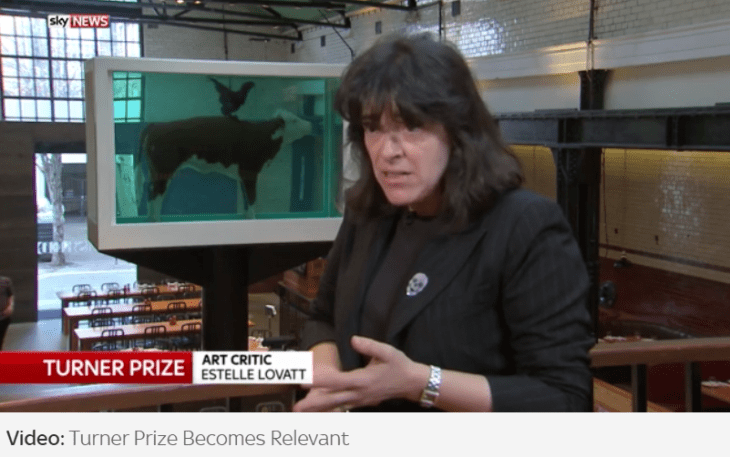
Art critic Estelle Lovatt says the prize is more relevant than ever this time round, with all the nominees having a social and political dimension to them.

“This year it’s extra special because the Turner Prize has its finger on the pulse of the nation,” she said.

“We’re really concerned this year about refugees, about people not being able to pay their bills – and this year we’ve actually got people bringing the community together through art.”

This year marks the first time the Turner exhibition has come to Scotland.

The prize will be presented in Glasgow, which has had 12 nominees and six winners in the past.

The other three nominees are Bonnie Camplin, Janice Kerbel and Nicole Wermers.

Assemble Announced 2015 Turner Prize Winner | itv

Assemble
Assemble’s Granby Four Streets helped regenerate an estate in Liverpool. Credit: PA

The Turner Prize 2015 has been awarded to the collective Assemble for their work Granby Four Streets that helped regenerate part of the Toxteth estate in Liverpool.

Sonic Youth singer Kim Gordon presented the award to members of the 16 member collective of artists, architects and designers, all aged under 30.

The London-based group’s work was commended for working across fields of art, design and architecture to create projects in tandem with communities in Liverpool who use and inhabit them.

Their spaces were praised by the community for promoting direct action and bringing art into everyday living.

Assemble collective artist Lewis Jones said winning the Turner Prize was “surreal”.

Nominees
Nominees (front row left-right) Bonnie Camplin, Janice Kerbel, Nicole Wermers and (back row left-right) Assemble collective members Lewis Jones, Amica Dall and Fran Edgerley. Credit: PA

We used the nomination to start up a new social enterprise, the Granby Workshop, based in Liverpool and employing local people to make products. All of the funds from that go back into that neighbourhood and continue the rebuilding of it after years of dereliction. We make tiles, doorknobs, fireplaces, all sorts of domestic products that are all handmade so each one is different and they really show an investment of time and care.

– LEWIS JONES, ASSEMBLE

Assemble have also worked on a playground in Dalmarnock in the east end of Glasgow, a child-led space for children to play in a “free and unencumbered way”, Jones said.

“I hope that this award and the nomination before it helps give recognition and value to different ways of creating places in our cities and around our homes,” he added.

Art critic Estelle Lovatt said that having Assemble as one of the nominees made this year’s Turner Prize different.

“Not since the Renaissance has art had such an input on the community,” she said, adding: “Leonardo da Vinci would have loved it.”

estelle

Assemble snatched the £25,000 prize from three other nominees: Bonnie Camplin, Janice Kerbel and Nicole Wermers.

Camplin was nominated for The Military Industrial Complex, South London Gallery – a study room of books and videos discussing conspiracy theories and unexplained incidences to explore “consensus reality”.

Kerbel was nominated for her operatic work Doug which narrates a series of hapless accidents that befall a fictional character using audio recordings, performance and printed matter.

And Wermers was nominated for her exhibition Infrastruktur, Herald Street, London, an installation of fur coats sewn into the back of chairs exploring art and design in consumer culture.

Via itv.  Follow this link to watch the video.

Design Collective Wins UK’s Turner Prize | Al Jazeera

Winning scheme for regenerating derelict houses in Liverpool seen as transcending traditional ideas about art.

Screenshot (136)

Assemble, a collective of 18 young architects and artists, has won Britain’s most prestigious award for art. Their scheme to regenerate derelict houses in Liverpool has been described as transcending traditional ideas about art.

On show in Glasgow is a replica of their Granby workshop, showing products used in the Liverpool renovations, which are also available online.

For $12 you can own an original tile made by a Turner Prize winner, which is pretty cheap considering this prize can transform careers, turning unknown artists into multimillionaires.

One former winner, Damien Hirst, is now the world’s richest living artist.

Al Jazeera’s Charlie Angela explains.

Watch the video on the Al Jazeera website.

‘BLAH-BLAH-BLAH-BLAH!’ by Deborah Azzopardi

BLAH-BLAH-BLAH-BLAH by Deborah Azzopardi

As usual, Deborah Azzopardi‘s wholly original style mixes the trend of the traditional, with the contemporary, with a story.

An original retro rotary dial corded telephone from the 1970s is held by a woman.

Who is she?
She is you; she is me.

Who is she talking to?
Her mother, her lover, her friend, you, me.

Blah blah blah blah, we hear chatter that’s familiar; irrelevant, insincere, boring, time-consuming babble, proving life’s too short to jaw when there’s shopping to do and lovers to love!

More than a painting, it’s real life.

Rarely does Azzopardi sell a painting that has been published.  Anyone can have a print, not everyone ‘the’ original.  Why keep your money in the bank when it’ll look prettier on your wall.

CNN Ones to Watch’ – Sculpture

screen-shot-2015-03-11-at-15-04-44

Sculptor Antony Gormley

  • Antony Gormley offers expertise on state of sculpture
  • Tate Modern’s Chris Dercon nominates Mexican, Abraham Cruzvillegas
  • Art critic Estelle Lovatt nominates South African, Jonty Hurwitz

The story of sculpture is carved into the landscape, taking all shapes and sizes, capturing a moment, claiming a space. Once in a while, the work of a great artist takes its place in history. With a range of materials and a forum of ideas more diverse than ever before, where will the next sensational sculptor be found?

‘CNN Ones to Watch’ in March explores this three-dimensional art form to find out which artists have the tools for the top.

One of the best-known sculptors working today, Antony Gormley, shares his thoughts on the state of the art, and the programme has enlisted two prominent voices – director of London’s Tate Modern Chris Dercon, and eminent British art critic Estelle Lovatt, to select their ‘Ones to Watch’.

Antony Gormley has created over two thousand sculptures based on his own body, the greatest of which is arguably the cast iron ‘Angel of the North’ which towers over the landscape and has become a British landmark. His work is exhibited in public spaces around the world, and he has received prestigious international arts awards including the Turner Prize and Japan’s Praemium Imperiale.

From his studio in London, where he’s preparing for a new exhibition in Paris, Second Body, Gormley tells ‘CNN Ones to Watch’: “You don’t get good work without good ideas but the ideas come from the work. Sculpture, of all the arts, is perhaps the most silent and the most filled. Learning to listen to the work that you’ve already made is really where all the core ideas come from. One work is the mother of the next.”

As director of Tate Modern, Belgian Chris Dercon oversees the most visited modern art museum in the world; last year, it welcomed over 5.5 million visitors.

Once a year, Dercon and his team commission a new artist to fill the largest space in Tate Modern, the Turbine Hall, an important platform for emerging sculptors since its opening in 2000. These commissions can catapult an artist to stardom, and have been a seminal moment in the career of many great artists, among them Ai Weiwei and Anish Kapoor.

Dercon has chosen Mexican sculptor Abraham Cruzvillegas to fill the Turbine Hall in October 2015, telling ‘CNN Ones to Watch’ why: “Abraham Cruzvillegas is not shy to take on the vastness of the Turbine Hall and to turn it into something completely else. That’s the magic of these artists that they are capable with sculpture, whether it’s tiny or large sculpture to turn the space into something else. Abraham Cruzvillegas offers you a very open work of art which you have to confront with your own experiences.”

‘CNN Ones to Watch’ travels to Mexico City, where Cruzvillegas’ story begins: “I am not a traditional sculptor carving marble or wood. It’s like testing myself that I can do something with anything. I use my own hair. I use shoes, I use plants, roots, potatoes, shirts, films everything for making sculptures.”

Cruzvillegas took as a reference his own experience of what he calls ‘autoconstruction’, related to the way people build their houses without money (in other countries ‘autoconstruction’ would be called favelas, or shanty towns, slums): “People are responding to their specific needs, so I do the same when I make a sculpture.”

Antony Gormley comments: “I’m interested in Abraham because I see him carrying on the work Orozco and others in Mexico started, which is really dealing with contemporary urban life from the point of nothing, from the street, and doing that in a very intelligent way, a very open way, and celebrating the inherent hope of those that make something from nothing.”

Respected British art critic Estelle Lovatt believes South African sculptor Jonty Hurwitz is   an artist taking the art of sculpture to new extreme, having worked with Hollywood animators and micro-physicists to create the world’s smallest sculpture.

Lovatt tells the show: “I’m very proud to nominate Jonty Hurtwitz as one of the artists to watch because no one works like him today. It’s a mix between the emotional and the intelligent and that’s what gives it the spark.”

‘CNN Ones to Watch’ captures Hurwitz’s figure of a woman who can only be viewed through a microscope, as she dances delicately on a single strand of human hair. His   quest to merge art and science is limitless – he makes vast bronze sculptures using algorithms and mirrors which play with perspectives.

The programme follows Hurwitz in the laboratory at one of the world’s leading universities in engineering and natural sciences, Karlsruhe Institute of Technology in Germany, as the alchemist turned artist crafts a new work.

He tells the programme: “A lot of the artistic expression that I bring to the world represents the absolute current moment in human development, whether it’s 3D printing, whether its technology or whether its science.”

Antony Gormley admires scientific innovation in art: “I think the whole world of nano-engineering is extraordinary because I think it opens up the opposite which is in a sense a limitless spatial potential for art. I think the division between art and science should never have happened. Both science and art need structure, they need discipline, but they also need intuition.”


Via: CNN Press Room, the official website for CNN’s public relations team.

www.cnn.com/onestowatch